VAT Reverse Charge Explained: Construction Rules, Invoices & VAT Returns 2026
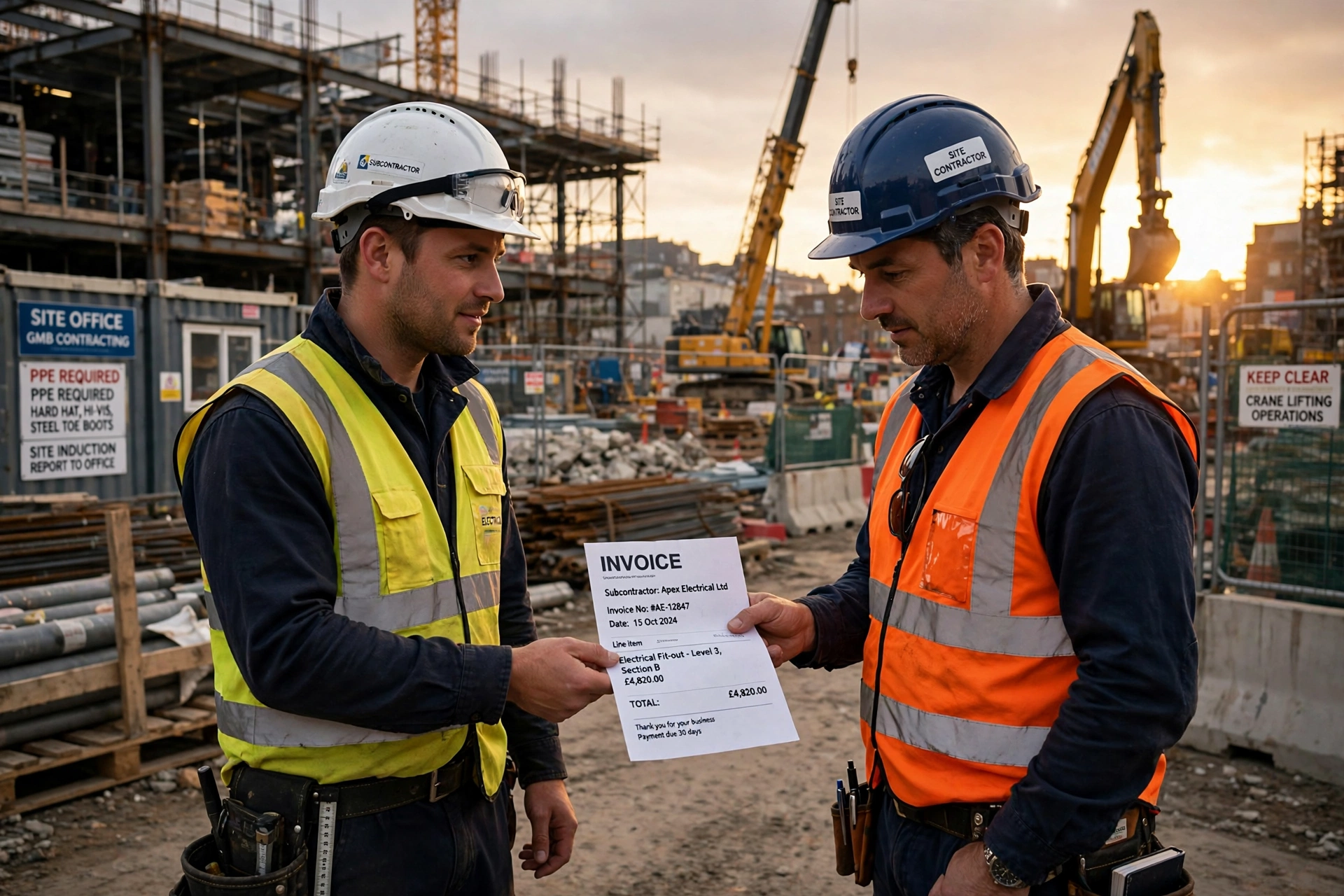
If you work in construction and a contractor has ever sent an invoice back with the words “you shouldn’t have put VAT on that”, you have already met the VAT reverse charge — probably the hard way. The VAT reverse charge is the rule that moves the job of accounting for VAT from the supplier to the customer on most construction work between VAT-registered businesses. The supplier invoices without VAT, and the customer declares that VAT on their own VAT return instead. No VAT cash ever changes hands between the two businesses. Get it right and it is just paperwork. Get it wrong in either direction and you are looking at credit notes, corrected returns, and awkward conversations about money you never collected or should never have charged.
This guide explains the VAT reverse charge in plain English: when it applies, when it does not, exactly what must appear on the invoice, which boxes of the VAT return it lands in, what it does to your cash flow, and the mistakes that catch real businesses out. Every number in the worked examples below was checked on the live calculator at ukvatcalculator.uk on 4 November 2026 — not copied from another guide, and not guessed.
What Is the VAT Reverse Charge?
Under normal VAT rules, the business doing the work adds VAT to its invoice, collects it from the customer, and pays it to HMRC on its next return. The domestic reverse charge for building and construction services, in force since 1 March 2021 under Section 55A of the VAT Act 1994, flips that round. The subcontractor (the supplier) issues an invoice for the net amount only. The contractor (the customer) works out the VAT itself and accounts for it on its own VAT return — as output tax and, where it is entitled to recover it, as input tax on the same return.
The point of the rule is fraud prevention. Before 2021, a subcontractor could charge VAT, get paid, and disappear without ever paying that VAT to HMRC — the classic “missing trader” fraud. If no VAT cash passes between businesses at all, nobody can disappear with it. The total tax due does not change; only who reports it changes.
It is worth being precise about the name. People in the trade usually call it the “CIS reverse charge” because it sits so closely on top of the Construction Industry Scheme (CIS). But they are two separate regimes doing two different jobs: CIS governs deductions from payments to subcontractors, while the VAT reverse charge governs how VAT is accounted for on the supply. One invoice can be affected by both at the same time.
When Does the VAT Reverse Charge Apply?
The VAT reverse charge applies only when every one of these conditions is true. Miss one, and normal VAT rules apply instead:
- Both businesses are VAT-registered in the UK (or required to be registered). If your customer is not VAT-registered — a private homeowner, for example — charge VAT normally.
- The payment is reported under the Construction Industry Scheme. The reverse charge is built on the CIS list of construction operations, so if the payment does not fall under CIS, the reverse charge does not bite.
- The service is a specified construction service. That covers constructing, altering, repairing, extending, demolishing or dismantling buildings or structures; civil engineering works such as roadworks, railways, docks and pipelines; installing heating, lighting, air-conditioning, ventilation, power, drainage, sanitation, water or fire protection systems; internal cleaning done in the course of construction; painting and decorating; and preparatory work such as site clearance, excavation, foundations, scaffolding and landscaping.
- The supply is standard-rated (20%) or reduced-rated (5%). Zero-rated work — for example, building a qualifying new home — stays under normal VAT rules.
- The customer is not an end user or intermediary supplier who has confirmed that status in writing (more on this below).
There is no minimum invoice value. A £100 repair job follows exactly the same rules as a £1 million contract. And there is no de minimis for the customer being “too small” — if the conditions are met, the charge applies.
When the VAT Reverse Charge Does Not Apply
Normal VAT rules apply instead of the VAT reverse charge in these cases:
- The customer is an end user. An end user is a VAT- and CIS-registered business that receives construction services for its own use and does not sell them on — a retail chain refitting its own head office, or a landlord having its own let property renovated. Crucially, a property developer building flats to sell is not an end user, and neither is a contractor whose own customer happens to be a homeowner: the contractor still sells construction services on, so the reverse charge still applies to the invoices it receives.
- The customer is an intermediary supplier. A business connected to an end user that passes the services straight on without materially changing them can be treated like an end user.
- The work is zero-rated or exempt. New residential construction is the big one.
- The service is excluded on its own. Under HMRC’s list, the reverse charge does not apply to the professional work of architects, surveyors and consultants; drilling for oil or gas; extracting minerals; manufacturing building components or delivering materials or plant to site; artwork; signwriting; installing seating, blinds and shutters; installing security systems such as burglar alarms and CCTV; or workers supplied by an employment business.
- The customer is not VAT-registered or the payment is not reported under CIS.
- The reverse-charge element is 5% or less of the whole supply. This is the “5% disregard”: if the qualifying part is tiny and both sides agree before work starts, normal VAT rules can apply to the whole invoice. It only works one way and must be agreed in advance — you cannot decide afterwards that it would have been more convenient.
The end-user trap deserves emphasis, because it is the single most common error. End-user status is never something you assume from the type of customer or project. It must be confirmed in writing — a line in the contract, on the purchase order, or in an email is enough for HMRC, and you must keep it with your VAT records. Without written confirmation, you must treat the customer as not an end user and apply the reverse charge. A developer can be an end user on one project and not on another, so check per job, not per customer.
What Must Appear on a VAT Reverse Charge Invoice?
A reverse charge invoice still carries all the normal invoice details, but with three differences:
- No VAT is added to the total. The customer pays the net amount only.
- The VAT rate or amount must still be shown. State the rate that would normally apply and the amount of VAT the customer must account for — an invoice that just says “reverse charge applies” with no figure attached is not compliant.
- Clear reverse-charge wording. HMRC accepts phrasing such as “Reverse charge: VAT Act 1994 Section 55A applies”, “Reverse charge: S55A VATA 94 applies”, or in plainer English, “Reverse charge: customer to pay the VAT to HMRC”.
Materials follow the same treatment as the service when they are part of a single supply. A supply-and-fit job is one supply, so the whole invoice — labour and materials together — falls under the reverse charge. Splitting labour and materials onto separate invoices does not change this. Materials supplied entirely on their own, with no construction service attached, are a different supply and sit outside the charge.
Worked Examples: VAT Reverse Charge Amounts, Verified Live
Here is where the numbers matter, because the VAT figure on a reverse charge invoice is the figure the customer will declare on their return. We ran every amount below through the free calculator on the ukvatcalculator.uk homepage — the same tool you can use to check your own invoices. The calculator’s “Add VAT” mode gives exactly the VAT amount a customer must account for under the reverse charge.
| Job (net amount) | VAT rate | VAT the customer accounts for | Customer pays supplier |
|---|---|---|---|
| First-fix electrics — £10,000 | 20% | £2,000.00 | £10,000 (not £12,000) |
| Commercial fit-out — £50,000 | 20% | £10,000.00 | £50,000 (not £60,000) |
| Reduced-rate renovation work — £2,500 | 5% | £125.00 | £2,500 (not £2,625) |
| Reduced-rate work — £10,000 | 5% | £500.00 | £10,000 (not £10,500) |
Take the first row in full. A subcontractor bills a VAT- and CIS-registered main contractor £10,000 for first-fix electrics, and the contractor is not an end user. The invoice shows £10,000 net, states that £2,000 VAT is accounted for under the reverse charge, and the total due is £10,000. The contractor declares the £2,000 as output tax and reclaims it as input tax on the same return (if fully entitled), so for most fully taxable businesses the two entries cancel out. If you are checking a gross figure instead — say a £12,000 invoice you suspect already includes VAT — the calculator’s reverse VAT calculator strips it back: £12,000 remove 20% gives net £10,000 and VAT £2,000, and £2,625 remove 5% gives net £2,500 and VAT £125.00. For ordinary add/remove checks, the add and remove VAT calculator and the gross to net calculator do the same job.
The video above is a real screen recording of the live calculator working through the three headline cases: £10,000 at 20% (£2,000 VAT), £50,000 at 20% (£10,000 VAT), and £2,500 at 5% (£125 VAT).
How the VAT Reverse Charge Appears on the VAT Return
This is where several popular guides get it wrong, so it is worth setting out carefully. The treatment depends on which side of the invoice you are on:
| VAT return box | Supplier (subcontractor) | Customer (contractor) |
|---|---|---|
| Box 1 — output tax | Nothing (no output VAT declared) | The VAT due on the purchase |
| Box 4 — input tax | As normal for your own purchases | Reclaim the same VAT (subject to normal recovery rules) |
| Box 6 — total sales ex VAT | Include the net sale value | Not affected (purchases never go here) |
| Box 7 — total purchases ex VAT | Not affected (sales never go here) | Include the net purchase value |
Handled correctly, the customer’s box 1 and box 4 entries offset each other, so the reverse charge is usually cash-neutral for the contractor. For the supplier, the sale still counts in box 6 — one widely read contractor guide wrongly tells suppliers to leave the transaction out of box 6 and customers to leave it out of box 7, which would understate both totals. If your software has a dedicated reverse-charge tax code, use it; if it does not, set one up before the next return, because a wrong code quietly posts amounts to the wrong boxes.

A Three-Tier Chain: Where Normal VAT Re-Enters
Chains are where the rule clicks into place. Subcontractor A supplies qualifying work to subcontractor B, who supplies the main contractor, who supplies an end user that has given written notification:
- A → B: reverse charge. A invoices net; B accounts for the VAT in boxes 1 and 4 and reclaims it.
- B → main contractor: reverse charge again. B invoices net; the contractor accounts for the VAT.
- Main contractor → end user: normal VAT. The end user gave written notice, so the contractor charges VAT on top in the usual way.
Only the final supply to the end user carries VAT on the invoice. Every link before it is net. If any link in the chain misjudges its customer’s status, the error propagates — which is why the written end-user notice matters more than any other single document in this regime.
What the VAT Reverse Charge Does to Cash Flow
For subcontractors, this is the part that actually hurts. Under normal VAT, a subcontractor collects VAT from the customer and holds it — sometimes for weeks — before it is due to HMRC. That gap is genuinely useful working capital, and plenty of smaller firms lean on it without quite calling it that. Under the VAT reverse charge, the gap is gone: on a £50,000 job, the subcontractor receives £50,000 instead of £60,000, and the £10,000 of VAT never sits in its bank account at all.
There is a flip side. A subcontractor that no longer charges VAT on most sales but still pays VAT on materials, tools and overheads may find its returns turning into repayment claims. In that situation, moving to monthly VAT returns can speed up repayments from HMRC and support cash flow — worth a conversation with your accountant rather than a decision made alone.
Two scheme interactions catch people out. First, reverse-charge supplies are excluded from the flat rate scheme: you collect no flat-rate VAT on them, so for a business doing mostly reverse-charge work, the flat rate scheme may stop paying for itself. Second, the cash accounting scheme cannot be used for reverse-charge supplies at all. If you are on either scheme, review whether it still works in your favour now that the reverse charge applies to your sales or purchases.

Common VAT Reverse Charge Mistakes — and How to Fix Them
- Charging VAT when the reverse charge should have applied. The most common error, mostly old habit. The contractor may refuse to pay the VAT element, or pay it and then be unable to recover it normally. Fix: issue a credit note, reissue the invoice correctly, and correct your own return if the VAT was already declared.
- Applying the reverse charge to an end user. Less common, worse: you now owe HMRC output tax you never collected. Chasing a customer for VAT weeks after the invoice was settled is an awkward conversation, and not always a successful one.
- Treating materials separately. If materials form part of a single construction supply, the whole invoice follows the reverse charge. Separate invoices do not split a single supply.
- Applying the reverse charge to zero-rated work. New-build housing is the classic case: normal VAT rules, not reverse charge.
- Missing the invoice wording or the VAT figure. Both are required, not optional extras.
- Using the wrong software tax code. Amounts then land in the wrong return boxes and the error repeats every month until someone notices.
One piece of advice found in a competitor guide deserves a direct correction: it suggests that if you are unsure, you should default to the reverse charge “rather than charge VAT without authority”. That is a dangerous default. Both directions of error cost you — a credit note and reissue one way, uncollected output tax the other. The safe default is not a treatment; it is a check: confirm the VAT number, confirm CIS status, and get the end-user answer in writing before the first invoice.
Three Errors in Other Guides, Corrected
Because this topic is full of confident-sounding misinformation, here are three specific corrections, each checked against HMRC’s own guidance:
- “The reverse charge started on 1 October 2019.” Wrong. That was only the originally announced date. It was delayed twice — first to 1 October 2020, then to 1 March 2021 — and has been in force since 1 March 2021.
- “Reverse-charge sales don’t go in box 6 and purchases don’t go in box 7.” Wrong, as the table above shows: the supplier includes the net sale in box 6, and the customer includes the net purchase in box 7.
- “Reverse-charge services don’t count towards the VAT registration threshold.” Wrong. They still count as taxable turnover towards the £90,000 threshold (in force since April 2024; deregistration threshold £88,000). A business approaching the threshold cannot ignore its reverse-charge work — and reverse-charge purchases count towards the customer’s threshold too.
A fourth, smaller one: one major software guide lists installing security systems as a covered service. HMRC’s excluded list expressly leaves out installing burglar alarms, CCTV and public address systems when supplied on their own. Check the service list, not just the headline.
VAT Reverse Charge and the 2026 Enforcement Climate
The rules themselves have not changed, but enforcement around them has tightened. New CIS fraud measures in force from 6 April 2026 allow HMRC to cancel gross payment status immediately, impose a five-year reapplication ban, and levy a 30% penalty on lost tax — even for businesses that did not know they were connected to fraud, where they knew or should have known their supply chain was connected to it. Sloppy reverse-charge coding is no longer just an admin error; in a supply chain under scrutiny, it is evidence. Keep the written end-user notices, the CIS verifications, and the VAT numbers on file for every job, and keep them for at least six years like the rest of your VAT records.
For the arithmetic itself, the site’s VAT formula guide sets out the underlying maths, and the VAT percentage calculator is handy when you need to work backwards from a gross figure to a rate. If you are still deciding whether you must register at all, remember the threshold is £90,000 of taxable turnover — not £85,000, a figure that went out of date in April 2024 and still appears in older guides.
Frequently Asked Questions
Does the VAT reverse charge apply to zero-rated construction work?
No. The VAT reverse charge applies only to standard-rated (20%) and reduced-rated (5%) construction services. Zero-rated work, such as building a qualifying new home, follows normal VAT rules.
Who pays the VAT under the VAT reverse charge?
The customer. The supplier invoices the net amount only, and the customer accounts for the VAT on its own VAT return — output tax in box 1, input tax reclaimed in box 4, net purchase value in box 7.
Is there a minimum invoice value for the VAT reverse charge?
No. There is no minimum value. An eligible £100 repair job follows the same rules as a £1 million contract.
What wording must a reverse charge invoice carry?
It must state clearly that the reverse charge applies and that the customer must account for the VAT, and it must show the VAT rate or the VAT amount. HMRC accepts “Reverse charge: VAT Act 1994 Section 55A applies”, “Reverse charge: S55A VATA 94 applies”, or “Reverse charge: customer to pay the VAT to HMRC”.
Does the VAT reverse charge apply to materials?
Yes, when materials are supplied as part of a single construction service — the whole invoice follows the reverse charge. Materials supplied entirely on their own, with no construction service, sit outside the charge.
Can I stay on the flat rate scheme if I do reverse charge work?
You can stay on the scheme, but reverse-charge supplies are excluded from your flat rate turnover, since you collect no VAT on them. If most of your work has moved to reverse charge, the scheme may no longer save you money, and the cash accounting scheme cannot be used for reverse-charge supplies at all.
General information only, not tax advice. VAT treatment turns on the facts of each supply — check the current HMRC guidance linked below or speak to a qualified adviser about your contracts. Official sources: GOV.UK — VAT domestic reverse charge for building and construction services and the HMRC internal manual VATREVCON22000 on the scope of the charge.
7 Comments