
VAT on Property: 2026 UK Guide — Free Calculator
VAT on property is the part of UK VAT that catches almost everyone out at least once — because the answer is never simply “20%”. Buying a house usually involves no VAT at all. Buying a new commercial unit can add 20% to the price. Converting an office into flats can be 5% on the building work and 0% on the sale. And the same building can be exempt, zero-rated or standard-rated depending on who sells it, when it was built, and whether anyone has opted to tax it. This guide works through every case with the actual rules, worked numbers checked on our free calculator, and the mistakes the other guides are still making — including two figures that changed in 2026 and that several big-name pages still get wrong.
If you only need the numbers, skip to the worked examples. If you are about to buy, sell, convert or let a property, read the whole thing: the expensive errors in this area are not arithmetic, they are choosing the wrong treatment in the first place.
VAT on property: the four treatments in one table
Every property transaction falls into one of four VAT treatments. The difference between zero-rated and exempt matters more than the rate itself, because in both cases the buyer pays 0% — but only zero-rating lets the seller reclaim the VAT on their own costs.
| Treatment | VAT charged | Seller reclaims input VAT? | Property example |
|---|---|---|---|
| Zero-rated (0%) | 0% | Yes — in full | First sale of a new home; first sale of a flat converted from an office |
| Reduced rate (5%) | 5% | Yes | Qualifying conversion or renovation work on a home |
| Standard rate (20%) | 20% | Yes | Sale of a new commercial building; sale or rent of an opted commercial building |
| Exempt | 0% | No — input VAT is stuck as a cost | Sale or letting of an existing home; sale or letting of an older commercial building (unless opted) |
That middle distinction is the one that costs real money. A developer who sells a new home for £300,000 charges 0% VAT and still reclaims every pound of VAT paid on bricks, labour and materials. A landlord who sells an existing house for the same £300,000 also charges 0% VAT — but cannot reclaim the VAT on the agent’s fees, the solicitor’s bill or the refurbishment. Same price, same 0% on the invoice, completely different economics. Hold that distinction in mind for everything that follows.
There is also a fifth category worth knowing: supplies “outside the scope” of VAT, which is not the same as exempt. A transfer of a going concern — selling a let building as a running rental business — is outside the scope, so no VAT is charged at all and it does not count as either a taxable or an exempt supply. We cover it in full below.
Buying a house: do you pay VAT on property when you buy a home?
For most homebuyers the answer is no. The sale of an existing residential property is exempt from VAT, so there is no VAT on the purchase price, no VAT to reclaim, and no VAT on the estate agent’s or solicitor’s fees charged to the seller — those fees carry 20% VAT, but that is VAT on professional services, not VAT on the house, and it is a cost the seller cannot recover.
Three things that are often confused with VAT on the purchase itself:
- Stamp Duty Land Tax (SDLT) is a separate tax on the purchase price. It is not VAT, and no VAT is charged on the SDLT itself. On a residential purchase the SDLT bands are 0% to £250,000, 5% from £250,001 to £925,000, 10% to £1.5 million and 12% above that, with first-time buyer relief at 0% up to £300,000. SDLT is dealt with in its own section below because it interacts with VAT on commercial purchases.
- VAT on the services around the purchase is always 20%: solicitors, surveyors, mortgage brokers and estate agents all charge standard-rate VAT on their fees, even when the property itself is exempt or zero-rated. On a £300,000 purchase the legal and survey fees alone can carry several hundred pounds of VAT that nobody can reclaim.
- VAT on a new home is 0%, not 20% — the first sale of a new dwelling is zero-rated, which is the subject of the next section. If a developer tries to charge you VAT on a brand-new house, something is wrong.
The short version for homebuyers: if the house has been lived in before, there is no VAT on the price. If it is brand new, there is no VAT on the price either — but for a different legal reason, and that reason is worth money to the developer, not to you.
New builds: why the first sale of a new home is zero-rated
The construction of a new dwelling, and the first sale — or long lease — of that dwelling by the person who built it, is zero-rated under Schedule 8, Group 5 of the Value Added Tax Act 1994. “First grant of a major interest” is the phrase HMRC uses: a major interest means the freehold, or a lease of more than 21 years in England and Wales (20 years or more in Scotland). Only the first grant qualifies. The second sale of the same house, even a month later, is exempt, not zero-rated.
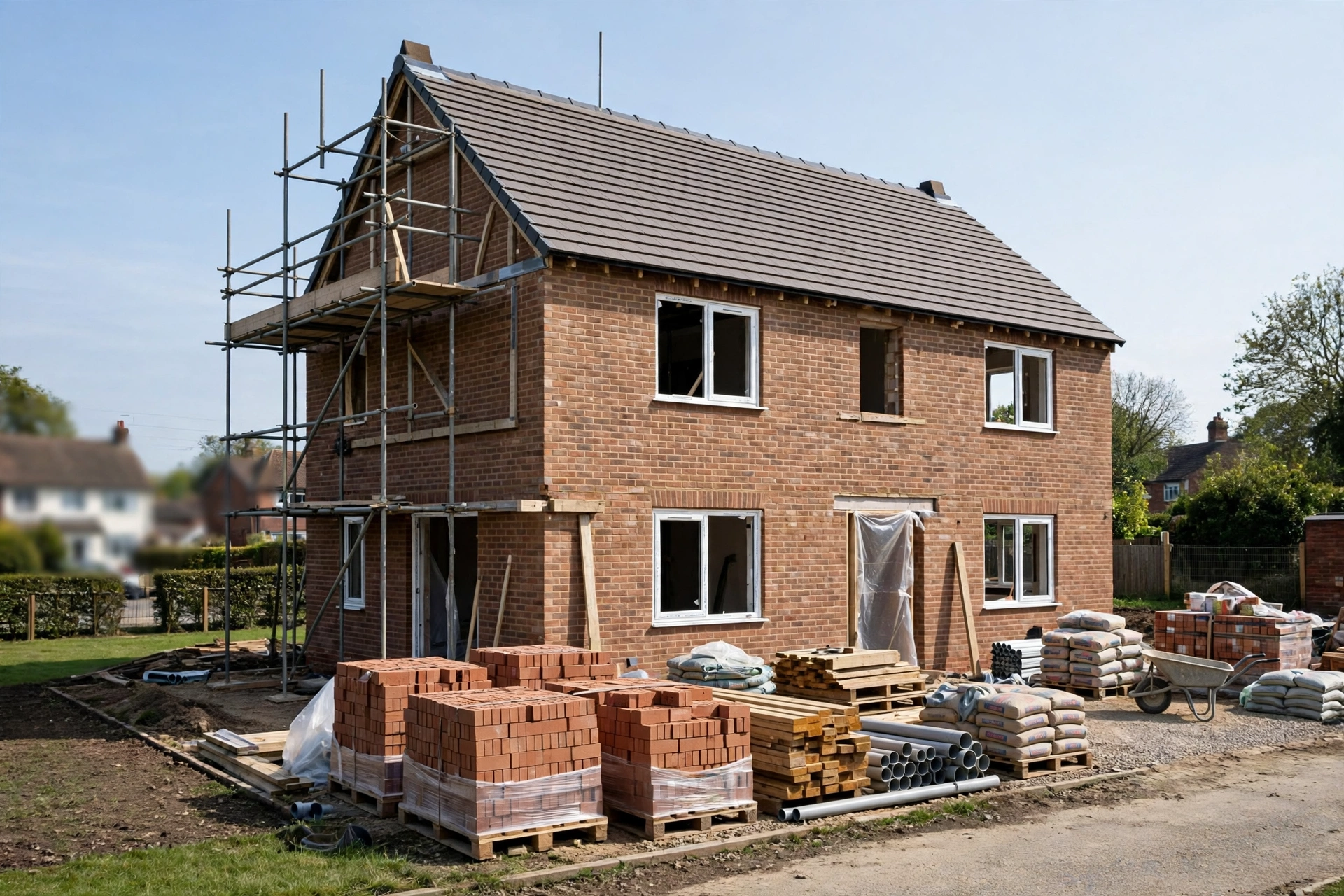
Zero-rating is what makes housebuilding work as a business. The developer charges 0% on the sale price but reclaims the VAT on everything that went into the build: materials, subcontractors, plant hire. Without it, the VAT on construction costs would be baked into every new home. The buyer does not “save” anything against the asking price — the price already reflects zero-rating — but it is worth understanding what the alternative would look like. A £300,000 new home sold at 20% would cost £360,000. That £60,000 is a counterfactual, not a discount: nobody actually pays it, and one popular buyer’s guide presents it as a “hidden saving”, which it is not.
The conditions, in plain terms:
- The building must be designed as a dwelling, or for a relevant residential or relevant charitable purpose.
- It must be built from scratch — any pre-existing building demolished completely to ground level (cellars, basements and the ground slab may stay), or rebuilt behind a single retained facade required by planning consent.
- The zero-rating covers the construction services and the building materials supplied and installed with them — fitted kitchens, built-in wardrobes, bathroom suites and central heating installed before the first sale.
- Upgrades agreed after completion are standard-rated at 20%. The well-known planning point is to negotiate upgrades before completion, while they can still be part of the zero-rated build.
- Professional fees — architects, planning consultants, solicitors — are standard-rated at 20% even on a zero-rated build. Only the construction services and incorporated materials are zero-rated.
Self-builders get a parallel route. If you build your own home (or convert a building into a home for yourself) and you are not VAT-registered, the DIY Housebuilders Scheme lets you reclaim the VAT on materials that are ordinarily incorporated into the building. You must claim within six months of the work being completed. White goods, furniture and carpets are excluded — they are not building materials. The scheme is covered in more detail below.
Commercial property: the 3-year rule and the 20% sale
Commercial property starts from the opposite default: the sale or lease of commercial land and buildings is normally exempt from VAT. The big exception is newness. The freehold sale of a commercial building completed less than three years ago is compulsorily standard-rated at 20%. The three years run from practical completion, or from first full occupation if that comes first.
So a developer who completes an office block in January 2026 and sells the freehold in January 2028 must charge 20% VAT on the price. Sell the same building in January 2030 and the sale is exempt — unless the seller has opted to tax it, which is the next section. The rule catches buyers by surprise because it is the only case where the age of the building, rather than anything the buyer or seller chooses, decides the VAT treatment.
Worked through on the calculator: a commercial unit sold for £250,000 excluding VAT, inside its first three years, carries £50,000 of VAT and a total price of £300,000. We verified that exact calculation live on ukvatcalculator.uk — net £250,000 at 20% gives VAT £50,000.00 and a total of £300,000.00. The same unit sold after the three years, with no option to tax, is £250,000 with no VAT at all. The £50,000 difference is decided entirely by the calendar.
Other commercial supplies are automatically standard-rated whatever the building’s age: car parks, caravan pitches, fishing rights and call options over land, among others. And bare land is exempt unless the owner has opted to tax it — which matters for developers, because a developer who buys opted land can reclaim the VAT on the purchase where the future sales of the homes built on it will be zero-rated.
The option to tax: turning an exempt building taxable
The option to tax is the single most important decision in commercial VAT on property. Under Schedule 10 of the Value Added Tax Act 1994, the owner of commercial land or a building can elect — “opt to tax” — so that supplies of that land or building which would otherwise be exempt become standard-rated at 20%. The owner then charges VAT on the sale price and on every rent invoice, and in return can reclaim the VAT on the purchase, the refurbishment and the professional fees.
Why would anyone volunteer to charge 20%? Because of the input VAT. Take a trade business buying its own workshop for £400,000, spending £100,000 on refurbishment and £15,000 on professional fees. Without an option, the VAT on all three — £80,000 on the purchase, £20,000 on the refurbishment, £3,000 on the fees — is an irrecoverable cost: £103,000 of dead money. With an option in place before the costs are incurred, the whole £103,000 is recoverable. That is the calculation that drives almost every option decision, and it is why the timing matters so much: the option must be effective before the costs are incurred, or HMRC permission is needed to recover VAT incurred earlier.
The mechanics, and the traps:
- Two steps, not one. First the decision to opt, then notification to HMRC on form VAT1614A. The notification must reach HMRC’s Option to Tax Unit within 30 days of the decision being made. The 30 days run from the decision, not from completion, and the option cannot be backdated. Miss the deadline and the option is ineffective.
- The 20-year lock. Once the cooling-off period ends, the option is effectively irrevocable for 20 years. There is a six-month cooling-off window (form VAT1614C) in which it can be revoked, and a route to revoke after 20 years (form VAT1614J). Between those two points there is no general exit. One guide we read describes this as merely “hard to reverse” — that understates it. For 20 years, every rent invoice and every sale carries 20% VAT.
- Permission first, in some cases. If exempt supplies have already been made in relation to the building, HMRC permission may be needed before opting (form VAT1614H). The VAT1614A form itself asks whether one of the automatic-permission conditions applies.
- The option binds the person, not the building. It does not transfer to a buyer. A buyer who wants the benefit must make their own option and notify HMRC before the relevant date — which is exactly where transfer-of-a-going-concern deals fail.
- It does not apply to dwellings. You cannot opt to tax a residential property. For buildings used by charities, the position is narrower than some guides state: the option can exist but is disapplied on specific grants, for example a grant to a charity for non-business use. Stating it as an absolute ban is wrong, and one of the guides we reviewed does exactly that.
- Part of a building can be opted in defined circumstances, despite the common claim that an option always covers the whole building and its land. The option attaches to the interest in land specified in the notification; the whole building plus its curtilage is the normal case, but part-building options exist. Do not rely on the simplified version.
- The tenant pays the price. Once a building is opted, every tenant pays 20% on top of the rent, whether or not that tenant can reclaim it. A bank, an insurer or a charity that cannot recover VAT bears the full 20% as a cost. Opting without checking the tenants is one of the seven costly mistakes listed below.
- The option lapses after six years with no interest in the land. If the opter disposes of their entire interest and holds nothing for six years, the option falls away — a detail only one competitor mentioned.
HMRC’s own guidance is VAT Notice 742A, Opting to tax land and buildings, and it is the document to read before making the election. Note also that HMRC no longer routinely sends a written acknowledgement of an option — keep your own proof that VAT1614A was sent and received.
VAT on rent: residential, commercial and holiday lets
Rent follows the same split as sales, with one category that behaves differently from both.
- Residential rent is exempt. A landlord letting a house or flat charges no VAT on the rent and cannot reclaim VAT on costs related to the letting — the agent’s fees, repairs, insurance. The VAT on those costs is simply part of running the property.
- Commercial rent is exempt unless the building is opted. Once opted, rent is standard-rated at 20% and the landlord reclaims the related input VAT. On a £30,000-a-year rent that means £6,000 of VAT and a £36,000 gross invoice. The same one-sixth rule is what our calculator verifies live: removing VAT from a £60,000 gross price returns £10,000 of VAT and a £50,000 net figure, and removing it from £120,000 returns £20,000 of VAT and £100,000 net — so £36,000 gross contains £6,000 of VAT and £30,000 net. Service charges follow the rent: if the rent is taxable, the service charge is taxable; if the rent is exempt, so is the service charge.
- Holiday and serviced accommodation is standard-rated at 20%. Furnished holiday lettings, Airbnb-style lets and serviced apartments are treated as hotel-style supplies, not residential lettings. The income counts towards the VAT registration threshold, so a holiday-let owner whose turnover passes £90,000 in a rolling 12 months must register for VAT — even though a buy-to-let landlord with the same income from long-term residential tenants would not. That distinction is missed by several guides, and it is the reason holiday-let owners are the residential landlords most likely to need VAT advice.
The registration threshold itself is £90,000 since 1 April 2024, with deregistration at £88,000. The rule that trips people up is what counts: zero-rated sales count towards the £90,000, exempt income does not. A developer selling £1.2 million of zero-rated new homes is compulsorily registerable. One guide we reviewed tells developers the opposite — that zero-rated sales do not require registration unless they choose it. That is wrong, and following it would leave a developer unregistered while making over a million pounds of taxable supplies.
Conversions and renovations: when 5% applies — and when it does not
The 5% reduced rate is the most misreported part of VAT on property. One buyer’s guide we reviewed prints a table stating “Renovation — 5%” and “Commercial Conversion — 20%” as blanket rules. Both are wrong. Most renovation and repair work on existing homes is standard-rated at 20%. And converting a commercial building into dwellings is 5% on the qualifying works — only commercial-to-commercial conversion is 20%. Here is the actual position, from HMRC’s VAT Notice 708 on buildings and construction.
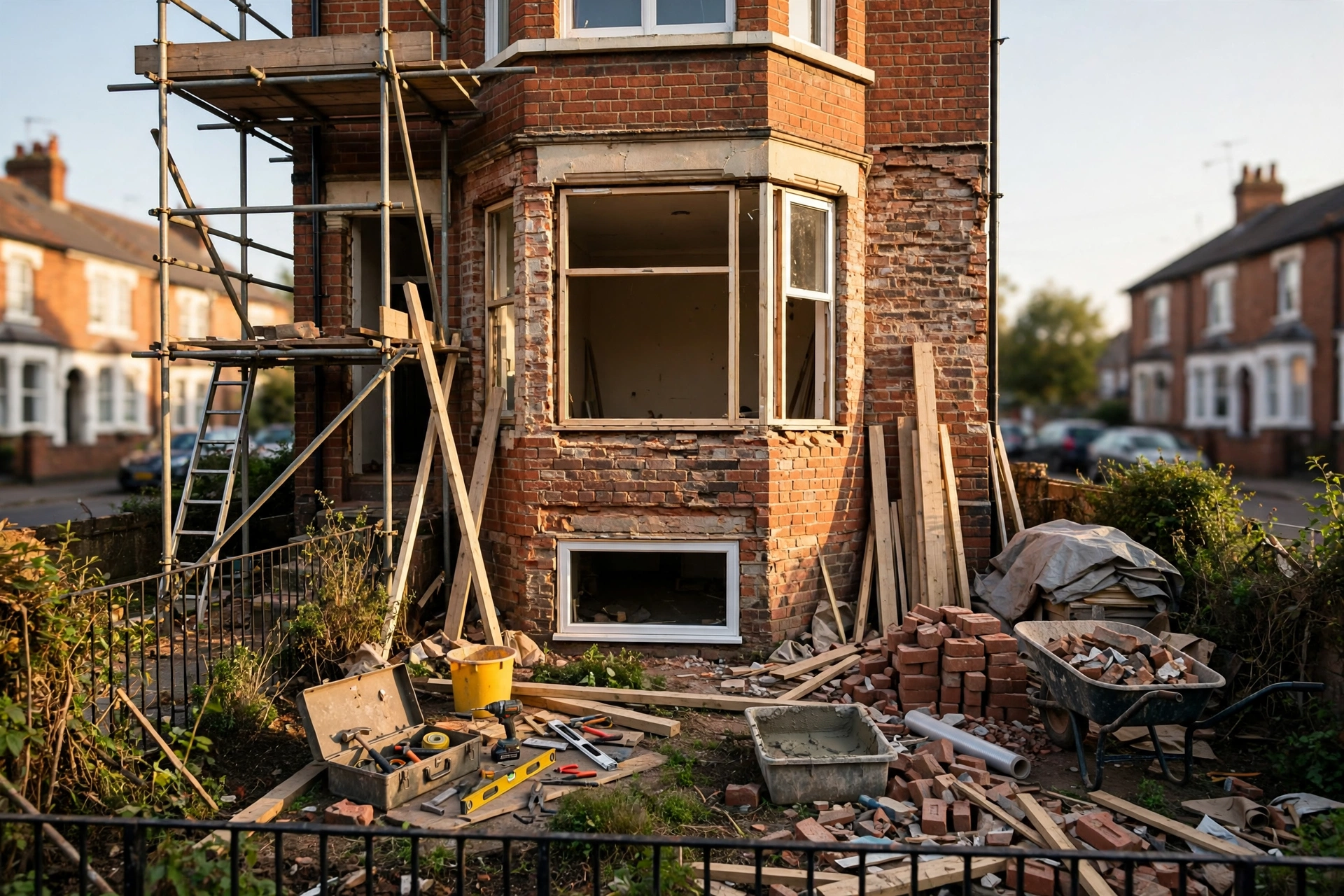
The 5% rate applies to qualifying residential conversion and renovation work only:
- Converting a non-residential building into a dwelling — an office, shop or warehouse turned into flats or a house. The builder’s services and the materials they supply and install are 5%.
- Changing the number of dwellings — one house split into two flats, or two flats combined into one house.
- Renovating a dwelling that has been empty for two years or more — the property must have been unoccupied for the whole two-year period before work starts.
- Converting a building for use solely for a relevant residential purpose, such as a care home or student accommodation.
What stays at 20% even on a qualifying project: the architect’s and surveyor’s fees, the solicitor’s bill, and any materials the owner buys directly rather than through the builder. The 5% rate covers the builder’s services and the materials the builder supplies and installs. A single dwelling converted into a house in multiple occupation is not automatically 5% either — the reduced rate applies where the work changes the number of dwellings or meets another qualifying category, and a shared house that remains a single dwelling for VAT purposes is standard-rated. One guide we reviewed claims planning permission and building control approval are the qualifying test. They are not.
The saving is large enough to plan around. On a £500,000 conversion, 5% VAT is £25,000 and 20% VAT is £100,000 — a £75,000 difference decided by whether the project qualifies. We verified the arithmetic live: net £50,000 at 5% gives VAT £2,500.00 and a total of £52,500.00, and a gross £105,000 at 5% contains £5,000.00 of VAT with a net of £100,000.00.
There is a second, separate question that is often confused with the 5% rate: the VAT on the sale of the converted property. The first sale or long lease of a dwelling converted from a non-residential building, by the person who did the converting, can be zero-rated — 0%, not 5%. That is the subject of the conversion section below, and the two rates must not be mixed up: 5% is the rate on the building work, 0% is the rate on the first sale.
Energy-saving materials: 0% until 31 March 2027
Installing qualifying energy-saving materials in residential accommodation — insulation, solar panels, heat pumps, electrical storage batteries — is zero-rated until 31 March 2027. From 1 April 2027 the rate returns to 5%. The zero rate applies to supply and installation by the installer; buying the panels yourself and paying someone else to fit them does not qualify. It covers residential accommodation and certain buildings used by charities — not offices, shops or workshops. The Autumn Budget on 28 October 2026 confirmed the reversion date and added heat batteries to the relief from 1 April 2027. If a contract is signed now for an installation finishing after 31 March 2027, the 5% rate is likely to apply, so the completion date — not the deposit date — is what matters.
Worked examples: the VAT inside real property prices
Every figure in this section was checked against the live calculator at ukvatcalculator.uk on 17 November 2026 — 15 test cases, all passing, covering add and remove at 20%, 5%, 0% and a custom 12.5% rate, plus zero and large amounts. The full test record is in the article’s test notes. The three examples below are also shown in the video underneath, recorded on the live calculator.
Example 1 — removing VAT from a VAT-inclusive commercial price. A commercial unit is advertised at £120,000 including VAT. How much of that is VAT, and what is the net price? The VAT inside a VAT-inclusive price at 20% is one-sixth of the gross: £120,000 ÷ 6 = £20,000. The calculator confirms it — VAT £20,000.00, net £100,000.00. If you are comparing an opted building at £120,000 inclusive with an exempt building at £100,000, the two prices are the same net figure; the £20,000 is tax, not value. Use the reverse VAT calculator for any VAT-inclusive price, and the gross-to-net VAT calculator when you need the net figure for a contract.
Example 2 — adding VAT to a commercial sale price. A developer sells a new office unit for £250,000 excluding VAT, inside its first three years, so the sale is standard-rated. VAT at 20% is £50,000 and the buyer pays £300,000 in total. Verified live: net £250,000 at 20% gives VAT £50,000.00 and a total of £300,000.00. A buyer who budgeted £250,000 and forgot the VAT is £50,000 short on completion day — and SDLT is then charged on the £300,000, not the £250,000, which adds a further cost covered in the SDLT section below.
Example 3 — the 5% conversion rate. A builder quotes £50,000 excluding VAT for converting a shop into a flat. At the 5% reduced rate the VAT is £2,500 and the total is £52,500 — verified live on the calculator. At the standard rate the same job would be £60,000. And if the quote is given VAT-inclusive at £105,000, the VAT inside it at 5% is £5,000 and the net price is £100,000 — also verified live. The 5% rate is one twenty-first of the gross price, against one-sixth at 20%, which is why the same job looks so different at the two rates. The add or remove VAT calculator runs both directions, and the VAT formula page shows the maths behind the one-sixth and one-twenty-first rules.
Example 4 — the zero-rated new build. A new home sold for £300,000 carries VAT of £0.00 — verified live, net £300,000 at 0% gives VAT £0.00 and a total of £300,000.00. The same applies to a gross price: £180,000 at 0% is £180,000 net with no VAT inside it. Zero-rated is not the same as “no VAT involved”: the developer reclaims the VAT on the build costs, which is exactly why the 0% rate exists.
Example 5 — development scale. A £1,000,000 development sold excluding VAT at 20% carries £200,000 of VAT and a £1,200,000 total — verified live. Large figures are where the calculator earns its keep: a 1p rounding slip on a £1,000,000 price is £200 of VAT, and the exact figures matter for contracts, SDLT and VAT returns. Two decimal cases were also verified: net £37,499 at 20% gives VAT £7,499.80 and a total of £44,998.80, and a gross £99,999 at 20% contains VAT £16,666.50 with a net of £83,332.50. A zero amount returns zero at any rate, and a custom rate works both ways — £1,000 at a custom 12.5% gives £125.00 of VAT, and £1,125 gross at 12.5% contains the same £125.00.
Converting a building into homes: the first sale can be 0%
The conversion rules reward the person who does the converting. The first sale or long lease of a dwelling converted from a non-residential building, by the person who converted it, is zero-rated — provided the building was not used as a dwelling or for a relevant residential purpose in the 10 years before the grant, and provided the person selling is the “person converting”. That last condition is the one that catches developers out, and it is the subject of the best-researched competitor page we found, a deep dive by Steve Bicknell.
- Person-converting status. The developer, contractor or subcontractor who does the conversion work — or commissions it — holds the status. Buying a completed conversion does not confer it. If you buy a finished office-to-flats conversion and sell the flats on, your sales are exempt, not zero-rated, because you did not convert the building. Status does not transfer between group companies either, and being in a VAT group does not solve it — although a transfer of a going concern can carry the status across in defined circumstances.
- The 10-year rule is measured at the grant date, not when the works started. If the building was used as a dwelling at any point in the 10 years before the sale, zero-rating fails. A building empty for nine years and eleven months at completion, but with residential use inside the window, does not qualify.
- The mixed-use trap. In Languard New Homes [2017] UKUT 307, flats that incorporated pre-existing residential accommodation did not qualify for zero-rating. A pub with a landlord’s flat above it, converted into flats, is the classic example: the parts that were already residential cannot be zero-rated on first sale. Apportionment follows.
- Letting before selling. Granting a short tenancy before the sale does not destroy zero-rating, because a short tenancy is not a major interest — but exempt letting can trigger input-VAT adjustments, so it is not free.
- VAT1614D. If you buy an opted commercial building intending to convert it to residential use, form VAT1614D certifies that intention and disapplies the seller’s option on the grant to you. Without it, you pay 20% VAT on the purchase price of a building you are about to turn into homes.
- Holiday homes and serviced apartments are excluded from conversion zero-rating. A converted flat sold as a holiday let is not a dwelling for this purpose.
Worked example from the competitor research, checked against our own numbers: an office converted into six flats sold at £250,000 each, with £80,000 of input VAT at stake. Zero-rating the sales lets the developer recover the £80,000; getting the treatment wrong turns it into an irrecoverable cost on top of the 20% that should never have been charged.
Transfer of a going concern: buying a let building without the VAT
When a property rental business is sold as a going concern — typically a let commercial building, with the tenants and the rental business continuing — the sale is outside the scope of VAT. No VAT is charged, no VAT is reclaimed, and the buyer does not have to fund 20% on the price while waiting to recover it. On a £2 million let building that is £400,000 of VAT that never changes hands. It is a statutory relief, not avoidance, despite one guide framing it as a way to “avoid” VAT.
The conditions are strict, and the timing is the trap:
- The buyer must be VAT-registered, or become registerable as a result of the transfer. It is not true, as one guide states, that both buyer and seller must be VAT-registered — the seller need not be in every case.
- The buyer must opt to tax the property and notify HMRC before the relevant date (normally completion), where the sale would otherwise be taxable — because the building is new, or because the seller has opted.
- The buyer must notify the seller, by the relevant date, that the option will not be disapplied.
- The same kind of business must continue, with no significant break. The tenants stay, the rents keep coming in, the business carries on.
- The seller bears the risk. If the conditions fail, HMRC treats the sale as a taxable supply and the seller owes the VAT — which is why sellers insist on the buyer’s notifications in writing before completion.
There is a second, quieter benefit: because no VAT is charged, SDLT is calculated on the net price rather than the VAT-inclusive price, which is the subject of the next section.
SDLT is charged on the VAT-inclusive price
Stamp Duty Land Tax is charged on the chargeable consideration, and where VAT is charged on a property purchase, the VAT forms part of that consideration. Buy the £2 million building above outside a transfer of a going concern, with the seller opted, and the price is £2.4 million including VAT — and SDLT is charged on £2.4 million, not £2 million.
On the non-residential SDLT bands — 0% to £150,000, 2% from £150,001 to £250,000, 5% above £250,000 — the SDLT on £2 million is £89,500 (2% of £100,000 is £2,000, plus 5% of £1,750,000 is £87,500). The SDLT on £2.4 million is £109,500 (2% of £100,000 is £2,000, plus 5% of £2,150,000 is £107,500). The VAT on the purchase therefore adds £20,000 of SDLT on top of the £400,000 of VAT itself. A transfer of a going concern removes both: no VAT, and SDLT on the £2 million net price. This is the calculation to run before completion, not after — SDLT is paid on the price as it stands on the day.
For residential purchases the SDLT bands are different and there is no VAT in the price to worry about, but the same principle applies to mixed-use purchases, where the residential and non-residential elements are taxed at different rates and the VAT treatment of each part must be worked out separately.
The Capital Goods Scheme changed on 29 July 2026: £600,000, not £250,000
The Capital Goods Scheme is the long tail of VAT on property. When a business spends a large amount on land, a building or civil engineering work and reclaims the VAT, the scheme requires it to monitor how the building is used for ten years, adjusting the input VAT recovered each year if the balance of taxable and exempt use changes. A building that starts fully let to taxable tenants and is later half-let to a bank — whose supplies are exempt — gives back some of the VAT year by year.
On 29 July 2026 the scheme changed more than it had in 36 years. The threshold for land, buildings and civil engineering works rose from £250,000 to £600,000 excluding VAT, and computers and computer equipment were removed from the scheme entirely. The changes were implemented by the Value Added Tax (Amendment) Regulations 2026 and confirmed by HMRC, and they are not retrospective: projects where capital expenditure was incurred before 29 July 2026 stay in the old scheme for their full ten-year period, and only expenditure first incurred on or after that date benefits from the new threshold.
This is the freshest correction in this article, and four of the ten guides we reviewed still get it wrong. LegalClarity, Pinsent Masons, TaxCalculatorsUK and Trade2Base all still state £250,000. Two of them were updated after the change took effect and still carry the old figure. The practical effect is large: a £400,000 refurbishment that would previously have meant ten years of annual CGS monitoring now falls outside the scheme altogether, provided no capital expenditure on it was incurred before 29 July 2026. A £700,000 project still falls inside it, with ten annual adjustments of one-tenth of the input VAT each.
The CGS rule from 29 July 2026: land, buildings and civil engineering works enter the Capital Goods Scheme only where qualifying expenditure is £600,000 or more excluding VAT. Computers are out entirely. Expenditure incurred before 29 July 2026 stays under the old £250,000 threshold for its full 10-year adjustment period. Aircraft, ships and boats remain in the scheme at £50,000.
VAT on land, mixed-use buildings and the DIY Housebuilders Scheme
Land. Bare land is exempt unless the owner has opted to tax it. A developer who buys opted land can reclaim the VAT on the purchase where the homes built on it will be sold zero-rated — but if the developer later changes intention and the land is used for exempt supplies instead, the reclaimed VAT can be clawed back within six years. The change-of-intention rule is one of the least-covered corners of VAT on property; only one of our ten competitors mentions it.
Mixed-use buildings. A shop with a flat above it is two supplies in one building, and the VAT treatment splits. The option to tax is disapplied in respect of grants of the residential parts, so the shop can be opted while the flat stays exempt. Input VAT must be apportioned between the taxable and exempt parts, which is where partial exemption comes in: input tax directly attributable to taxable supplies is recoverable, input tax on mixed costs is apportioned, and the de minimis limits — £625 a month on average, and 50% of total input tax — decide whether small amounts of exempt input tax can be recovered anyway. Only two of our ten competitors explain partial exemption in a property context, and none works it through a mixed-use example.
Lease premiums and long leases. On a lease of more than 21 years, only the premium — and the first rent, if any — is zero-rated on a first grant. Later rents are exempt. A developer granting a 25-year lease of a new flat for a £200,000 premium plus £500 a year ground rent zero-rates the premium and exempts the ground rent.
The DIY Housebuilders Scheme. If you build your own home or convert a building into a home for yourself, and you are not VAT-registered, you can reclaim the VAT on building materials ordinarily incorporated into the building — bricks, timber, plaster, fitted kitchens, but not white goods, furniture or carpets. The claim must be made within six months of the work being completed, and the scheme is set out in VAT Notice 431C. The trap is the rate charged in the first place: the refund only works if the builder charged VAT correctly, so a builder who wrongly charges 20% on work that should have been 5% costs you money twice.
Domestic reverse charge for construction services
Since 1 March 2021, the VAT domestic reverse charge has applied to building and construction services supplied between VAT-registered businesses where the payments are reported under the Construction Industry Scheme. The supplier issues an invoice without VAT, and the customer accounts for the VAT on both sides of their VAT return — output tax and input tax in the same return, netting to nil where the customer can recover the VAT in full.
The reverse charge applies to standard- and reduced-rated construction services. It does not apply to professional services — architects, surveyors and consultants still charge VAT in the normal way — and it does not apply to supplies of materials alone, or to supplies to a customer who is not VAT-registered. Only one of the ten guides we reviewed covers the reverse charge at all, which is a serious gap: a subcontractor who charges VAT on a reverse-charge supply, or a contractor who pays it, creates a VAT return error that HMRC’s own guidance says should not happen. If you work in construction, read HMRC’s reverse-charge guidance alongside VAT Notice 708, and see our guide to VAT reverse charge for the worked position.
7 costly mistakes with VAT on property
One of the guides we reviewed promises “7 Costly Mistakes” in its title and then never lists seven. Here are seven real ones, each with a price attached.
- Charging 20% on a qualifying conversion. Treating an office-to-flats conversion as standard-rated work costs £75,000 on a £500,000 job — the difference between 5% (£25,000) and 20% (£100,000). Check the qualifying categories before the builder’s first invoice, not after the last one.
- Assuming every residential sale is exempt. The first sale of a new home is zero-rated, and the first sale of a converted dwelling can be zero-rated too. Exempt and zero-rated both charge 0%, but only zero-rating lets the seller reclaim the input VAT. On a development, that is the whole construction VAT.
- Opting to tax without checking the tenants. An option turns every rent invoice into a 20% invoice for 20 years. A tenant who cannot reclaim VAT — a bank, an insurer, a charity — bears the full 20% as a cost, and may leave or renegotiate. Run the tenant check before the VAT1614A goes in.
- Missing the 30-day VAT1614A deadline. The notification must reach HMRC within 30 days of the decision to opt. The option cannot be backdated, and a late notification means the option is ineffective — so the purchase VAT you planned to recover stays irrecoverable.
- Getting TOGC timing wrong. The buyer must opt, notify HMRC and notify the seller that the option will not be disapplied, all before the relevant date. One missed notification turns a £2 million no-VAT sale into a £2 million plus £400,000 VAT sale, with £20,000 of extra SDLT on top — and the seller bears the risk.
- Forgetting SDLT is charged on the VAT-inclusive price. VAT on a purchase is part of the chargeable consideration for SDLT. Budgeting SDLT on the net price when the price carries VAT understates the tax by £20,000 on a £2 million opted purchase.
- Using the old figures. The registration threshold is £90,000, not £85,000 — that figure ended on 31 March 2024. The Capital Goods Scheme threshold is £600,000, not £250,000, since 29 July 2026. And zero-rated sales count towards the registration threshold while exempt income does not. Three of the ten guides we reviewed still state at least one of these wrong, including a page updated in December 2025 that still says £85,000.
What the other guides get wrong: the corrections in one place
We read the ten highest-ranking pages for “vat on property” in full. Four errors matter enough to name:
- Pinsent Masons (updated 5 December 2025) still states the registration threshold is “currently £85,000”. It has been £90,000 since 1 April 2024, with deregistration at £88,000. The same page says “the UK VAT system is based on EU law”, which has not been true since Brexit.
- LegalClarity, Pinsent Masons, TaxCalculatorsUK and Trade2Base all still state the Capital Goods Scheme threshold as £250,000. Since 29 July 2026 it is £600,000 excluding VAT for new items, computers have been removed from the scheme, and the old threshold applies only to expenditure incurred before that date.
- DNS Associates tells developers they are “not required to register for VAT unless you choose to” on zero-rated sales. Zero-rated sales count towards the £90,000 threshold, so registration is compulsory over it. The same page overstates the HMO rule: converting a single dwelling into a shared house is not automatically 5%.
- New-Builds prints a VAT table stating “Renovation — 5%” and “Commercial Conversion — 20%”. Most renovations are 20%, and commercial-to-residential conversion works are 5%. The same page sells the £60,000 zero-rating figure on a £300,000 home as a “hidden saving”, when the market price already reflects it.
The full comparison, with all ten pages, their strengths and every error found, is in the research notes for this article. The point of listing the corrections here is not to embarrass other guides — it is that these are exactly the figures a buyer, developer or landlord will act on, and acting on the old ones costs money.
For the mechanics behind the numbers in this guide — the one-sixth rule for removing 20% VAT, the one-twenty-first rule at 5%, and the add, remove and reverse calculations — see the VAT formula page and the VAT percentage calculator. For registration, returns and schemes, see our guides to how to register for VAT, how to file a VAT return, the Flat Rate Scheme and common VAT mistakes. HMRC’s own guidance is VAT Notice 708: Buildings and construction and VAT Notice 742A: Opting to tax land and buildings.
Frequently asked questions
Do I pay VAT when buying a house in the UK?
No. The sale of an existing residential property is exempt from VAT, so there is no VAT on the purchase price. The first sale of a brand-new home is zero-rated at 0%, which also means no VAT on the price — but the developer can reclaim the VAT on the build costs. You do pay 20% VAT on the solicitor’s, surveyor’s and estate agent’s fees, and Stamp Duty Land Tax is a separate tax on the price.
Do you pay VAT on commercial property?
It depends on the building’s age and whether it has been opted. The freehold sale of a commercial building completed less than three years ago is standard-rated at 20%. After three years the sale is exempt, unless the seller has opted to tax the building, in which case 20% applies. A £250,000 sale inside the three years carries £50,000 of VAT and a £300,000 total.
Is VAT charged on rent?
Residential rent is exempt, so no VAT. Commercial rent is exempt unless the building has been opted to tax, in which case it is 20% — a £30,000 annual rent becomes £36,000. Holiday lets and serviced accommodation are standard-rated at 20% and the income counts towards the £90,000 VAT registration threshold.
Can I reclaim VAT on a commercial property purchase?
Yes, if you are VAT-registered, the seller charged VAT (because the building is new or opted), and you will use the building to make taxable supplies. On a £400,000 purchase plus £100,000 of refurbishment and £15,000 of fees, an option to tax makes £103,000 of VAT recoverable. If the purchase is a transfer of a going concern, no VAT is charged at all.
What is the option to tax?
It is an election under Schedule 10 of the Value Added Tax Act 1994 that turns an exempt supply of land or a building into a standard-rated one at 20%. The owner notifies HMRC on form VAT1614A within 30 days of the decision. The option lasts 20 years, with a six-month cooling-off period, and it lets the owner reclaim VAT on the purchase, refurbishment and fees. It does not apply to dwellings and it does not transfer to a buyer.
Is VAT charged on a property conversion?
Qualifying conversion work — turning a non-residential building into a dwelling, changing the number of dwellings, or renovating a home empty for two years or more — is charged at the 5% reduced rate. Ordinary repairs and renovations are 20%, and professional fees are always 20%. The first sale of the converted dwelling, by the person who converted it, can be zero-rated at 0%.
Do I need to register for VAT if I sell property?
You must register when your taxable turnover passes £90,000 in a rolling 12-month period. Zero-rated sales count towards that threshold, so a developer selling new homes must register once sales pass £90,000. Exempt income, such as residential rent or the sale of an existing home, does not count. You can also register voluntarily below the threshold to reclaim VAT on your costs.