
VAT on Construction: 2026 UK Guide — Free Calculator
Getting VAT on construction wrong is one of the most expensive mistakes in the UK building trade. Charge 20% on a job that should be zero-rated and your customer overpays by thousands — and may never come back. Charge 5% on a job that should be 20% and HMRC can come after you for the difference, plus penalties and interest, years later. The rules sit in HMRC’s VAT Notice 708, a document of more than 4,000 lines, and several of the guides that rank for this topic get headline facts wrong: one says the DIY housebuilders’ deadline is three months (it is six), another calls charity construction “VAT-exempt” (it is zero-rated), and a third applies a 10-year test to the 5% rate where no 10-year test exists.
This guide works through the rules in plain English, with the exact conditions HMRC applies, the figures that decide each rate, and worked examples verified on the live calculator at ukvatcalculator.uk. Every rate claim is checked against VAT Notice 708 (last updated 26 August 2026) or the gov.uk builder guides. Where a competitor gets it wrong, this guide says so and gives the correct position.
VAT on construction: the short answer
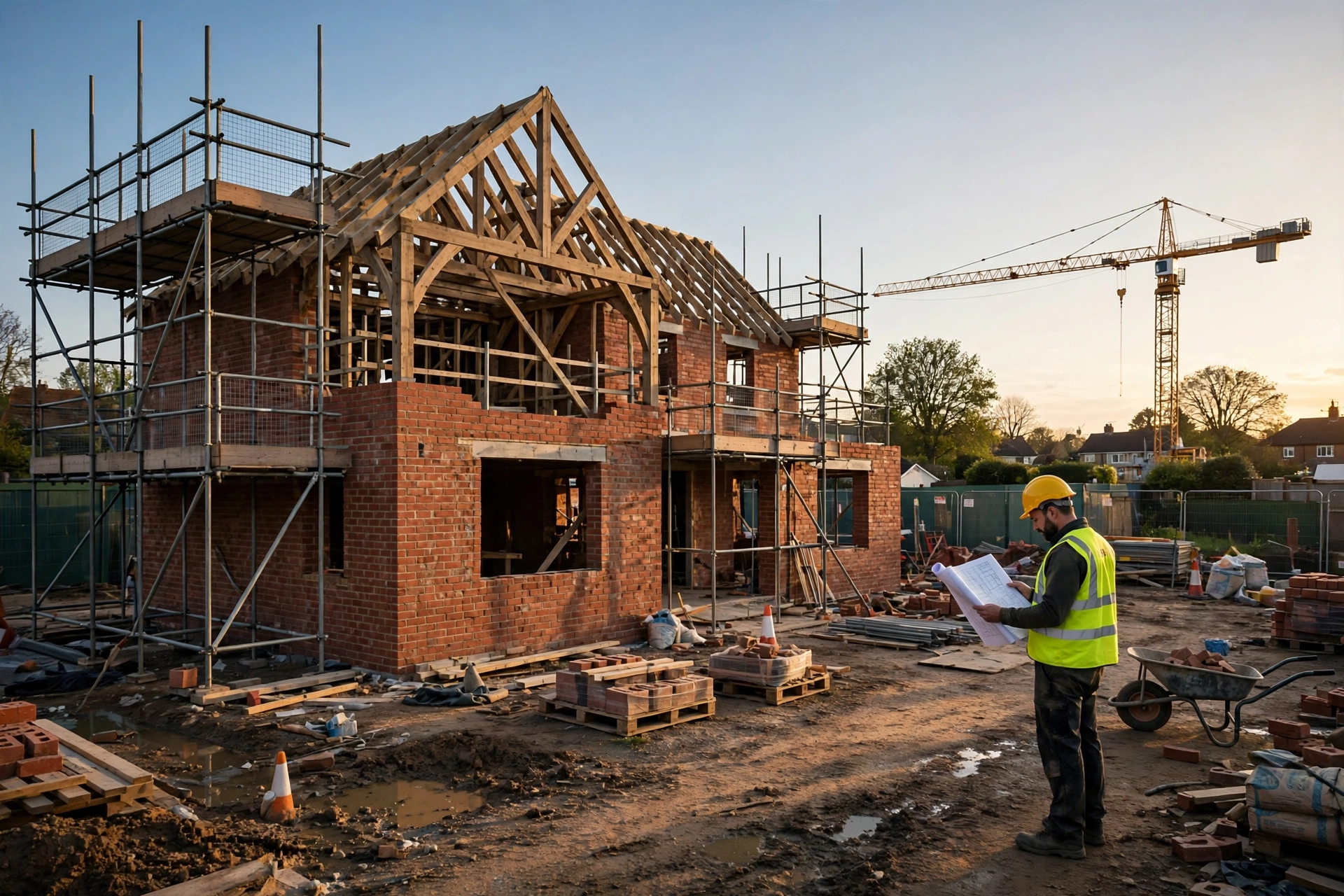
The default rate for building work in the UK is 20%. Two exceptions exist. Construction of a new qualifying dwelling — a house or flat built from scratch — is zero-rated at 0%, as is its first sale or long lease by the person who built it. And the reduced rate of 5% applies to a narrow list of jobs: qualifying conversions, renovating a home that has stood empty for at least two years, and installing specified energy-saving materials (which are 0% until 31 March 2027, then revert to 5% on 1 April 2027). Everything else — repairs, extensions, alterations to existing buildings, listed-building work, professional fees, and materials bought over the counter — is 20%.
Three further rules catch builders out. First, the rate follows the job, not the labour: materials a builder supplies and fits take the same rate as the service, while materials bought over the counter are 20%. Second, the domestic reverse charge, in force since 1 March 2021, moves the VAT on most business-to-business construction services from the subcontractor to the customer — it never changes the rate, only who accounts for the VAT. Third, zero-rated work still counts towards the £90,000 VAT registration threshold, because zero-rated supplies are taxable supplies, not exempt ones.
The three rates on building work at a glance
Almost every construction job falls into one of the three rows below. If a job does not fit the 0% or 5% row exactly, it is 20% — the exceptions are strict, and HMRC applies them literally.
| Rate | What it covers | Key condition |
|---|---|---|
| 0% — zero-rated | Construction of a new qualifying dwelling, a relevant residential-purpose building or a relevant charitable-purpose building; first sale or long lease (21+ years) of a new dwelling by the person who built it | Built from scratch; all four “designed as a dwelling” conditions met; certificate held where required |
| 5% — reduced rate | Qualifying conversions; renovating a dwelling empty for 2+ years; energy-saving materials (0% until 31 March 2027) | Number of dwellings changes, or a non-residential building becomes a home; empty-home proof on file; work apportioned part by part |
| 20% — standard rate | Everything else: repairs, maintenance, extensions, alterations to existing buildings, listed-building work, commercial buildings, professional fees, plant hire, materials bought over the counter | The default — no exception needs to be proved |
The difference between the rates is not academic. Take a net £80,000 job — a typical mid-size building contract — and run it through the calculator at each rate. The figures below were verified on the live calculator on 20 November 2026:
| Net contract value | Rate | VAT | Total to pay |
|---|---|---|---|
| £80,000 | 0% (new dwelling) | £0.00 | £80,000.00 |
| £80,000 | 5% (qualifying conversion) | £4,000.00 | £84,000.00 |
| £80,000 | 20% (extension or repair) | £16,000.00 | £96,000.00 |
Same £80,000 of work, three different bills — £80,000, £84,000 or £96,000. That £16,000 gap is why the rate question matters, and why getting it wrong in either direction is expensive. Check any figure yourself on the add or remove VAT calculator — enter the net amount, pick the rate, and the VAT and total appear instantly.
Zero-rated VAT on construction: new dwellings built from scratch
The most valuable relief in VAT on construction is the zero rating for new buildings. Under VAT Notice 708, section 3, construction of a qualifying building is zero-rated when four things are true: a qualifying building is being constructed, the services are made “in the course of construction”, a valid certificate is held where one is required, and the services are not on the excluded list. A qualifying building is one designed as a dwelling, or used solely for a relevant residential purpose (such as a care home or student accommodation), or solely for a relevant charitable purpose.
“Designed as a dwelling” has four conditions, and all four must hold:
- The building is self-contained living accommodation.
- There is no direct internal access to any other dwelling.
- It is constructed in accordance with statutory planning consent.
- There is no prohibition on its separate use or disposal.
The fourth condition is the annexe trap. A granny annexe built with a planning condition that forbids its separate sale or letting fails the test and is standard-rated at 20%, even though it looks like a dwelling and functions like one. On a £70,000 annexe job that is a £14,000 difference — and it is the condition most often missed, because the builder may never see the planning condition.
“Built from scratch” is also literal. Any pre-existing building must be demolished completely to ground level, although cellars, basements and the ground-floor slab may be retained. A retained facade counts only where planning consent requires it. An extension to an existing building is an alteration at 20%, however new it looks and however much of the old building is replaced. This is the single most common mis-rating in the trade: an extension is never a new build for VAT purposes.
What stays at 20% on a zero-rated site
Zero rating does not cover everything on a new-build site. Architects, surveyors, consultants and supervisors are always 20%, unless their services are no more than a cost component of a design-and-build contract. Hire of plant, scaffolding, security fencing and mobile offices on their own is 20% — although erecting and dismantling scaffolding can be zero-rated as part of the construction service. Work after completion is 20%, except correcting defects in the original work (snagging). And fixing somebody else’s snags is 20% too.
A £120,000 gross contract on a new build illustrates the arithmetic. Verified on the live calculator: £120,000, remove 20%, gives VAT of £20,000.00 and a net amount of £100,000.00 — that is the VAT sitting inside a standard-rated price of the same size. On a genuinely zero-rated new build, the same £100,000 of work carries no VAT at all, so the customer pays £100,000 instead of £120,000. Use the reverse VAT calculator whenever a quote arrives VAT-inclusive and you need to see what the net figure is before deciding the rate.
The first sale and the holiday-home exception
The zero rating extends to the first sale, or a long lease of 21 years or more, of a new qualifying dwelling by the “person constructing” — the person who built it (Notice 708, section 4). Later sales are exempt, not zero-rated, which matters because an exempt seller cannot reclaim input tax on the sale in the way a zero-rated seller can. Holiday homes cannot be zero-rated on sale. A £240,000 new-build contract value at 0% carries no VAT at all — verified on the live calculator: £240,000, add 0%, gives VAT £0.00 and a total of £240,000.00. The same figure as a gross amount with the VAT stripped out is also £240,000 at 0%: £180,000, remove 0%, gives VAT £0.00 and a net of £180,000.00.
Zero-rated work also counts towards the VAT registration threshold. The threshold is £90,000 of taxable turnover in a rolling 12 months, in force since 1 April 2024, with a separate forward-looking test: if you expect to exceed £90,000 in the next 30 days alone, you must register. Some older guides still quote £85,000 — that figure was superseded in April 2024 and is wrong. A builder doing only zero-rated new builds still has to register once turnover passes £90,000, because zero-rated supplies are taxable supplies; only exempt supplies are outside the threshold. If you are near the line, our guide on how to register for VAT walks through the process.
The 5% rate for conversions
The 5% reduced rate for conversions is the most useful relief for builders working on existing buildings, and the most misunderstood. Under Notice 708, section 7, three kinds of conversion qualify:
- Converting premises so that the number of single household dwellings changes — up or down. One house split into two flats qualifies; two flats knocked back into one house qualifies.
- Converting non-residential premises into dwellings — premises that were never lived in, or a dwelling adapted in its entirety to another use, such as offices or a dental practice.
- Converting premises into multiple occupancy dwellings (bedsits) or premises for a relevant residential purpose.
Work is judged part by part, floor by floor. In a block of flats, only the floors where the number of dwellings actually changes get 5%; the rest is 20%. If statutory planning consent or building control approval is required and has not been granted, the work is 20%. And the conversion must be a genuine conversion: a barn that was never lived in qualifies for 5% regardless of how long it has stood empty. There is no 10-year test for the 5% conversion rate — that test belongs to the zero-rated sale of a converted dwelling, covered below, and one widely read guide conflates the two.
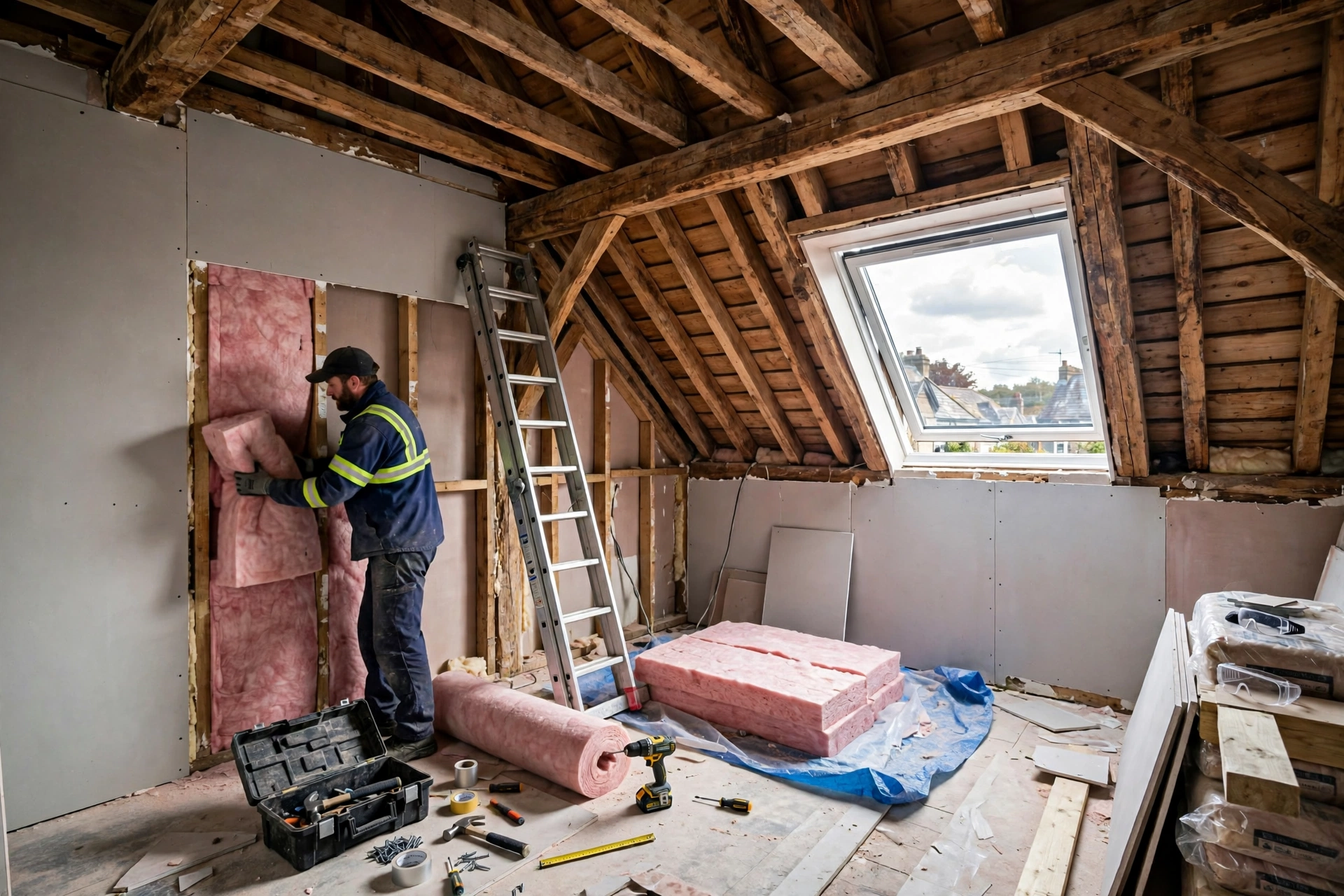
The money at stake is large. A barn conversion with a net contract value of £100,000 at 5% carries VAT of £5,000.00, for a total of £105,000.00. The same £100,000 at 20% carries VAT of £20,000.00, for a total of £120,000.00 — a £15,000 difference on one job. Both figures were verified on the live calculator on 20 November 2026. A smaller conversion tells the same story at domestic scale: £12,000 net at 5% is VAT £600.00 and a total of £12,600.00, while £12,600 quoted VAT-inclusive at 5% strips back to VAT £600.00 and a net of £12,000.00. A renovation quote of £9,600 net at 5% is VAT £480.00 and a total of £10,080.00.
One more trap: the 5% rate does not cover everything inside a conversion job. Installation of goods that are not building materials — carpets, fitted bedroom furniture — erection and dismantling of scaffolding, hire of goods, landscaping, and professional services all stay at 20%. And if you do not apportion the bill between the 5% work and the 20% work, none of the work gets the reduced rate. Apportionment is not optional paperwork; it is the price of the relief.
The 5% rate for empty homes
The second 5% route is renovating or altering a dwelling, or premises for a relevant residential purpose, that has not been lived in during the two years immediately before work starts (Notice 708, section 8). The proof HMRC accepts is practical: Electoral Roll entries, Council Tax records, utility bills, or a letter from the Empty Property Officer — and a letter from the Empty Property Officer alone is sufficient. Squatters, property guardians and storage use are ignored; they do not count as living there. Occasional use as a second home does count as lived in, and it kills the relief.
There is one exception worth knowing. If the new owner has already moved in before work starts, the main contractor can still charge 5%, but a subcontractor must charge 20% (paragraph 8.3.4). It is one of three subcontractor exceptions in the notice — the others are certificated buildings and housing-association conversions — and it is the one that most often produces a wrong invoice, because the subcontractor sees a 5% job and copies the main contractor’s rate.
Empty-home work is where the calculator earns its keep on small numbers. A gross renovation price of £31,500 at 5% strips back to VAT £1,500.00 and a net of £30,000.00 — verified on the live calculator. That £1,500 is the VAT inside the price; on a standard-rated renovation of the same size the VAT inside would be £5,250.00. Check any empty-home quote with the gross to net VAT calculator before agreeing the rate with the customer.
Two years versus ten years: do not mix them up
The two numbers that cause the most confusion in VAT on construction are two years and ten years. They belong to different reliefs, and swapping them is exactly the error one top-10 guide makes. The table below separates them once and for all.
| Test | What it decides | Relief | Proof HMRC accepts |
|---|---|---|---|
| 2 years empty | Whether renovation work on a dwelling gets the reduced rate (Notice 708, s.8) | 5% on the building work | Electoral Roll, Council Tax, utilities, or an Empty Property Officer letter alone |
| 10 years empty | Whether the first sale or long lease of a dwelling converted from a non-residential building is zero-rated (Notice 708, s.5) | 0% on the sale — not on the building work | Electoral Roll, Council Tax, utilities, Empty Property Officer letter; occasional use (e.g. second home) in the 10 years kills it |
Notice the distinction: the 2-year test changes the rate on the work; the 10-year test changes the rate on the sale. The conversion work itself is 5% either way (for an ordinary converter), and the 10-year test never decides the rate on building work. Housing-association conversion work is the exception that proves the rule — it is zero-rated under section 6, not 5% — which is why an ordinary converter who reads that housing-association conversions are zero-rated and copies the rate is wrong.
Listed buildings: the relief that ended in 2012
Alterations to listed buildings used to be zero-rated. That relief was withdrawn on 1 October 2012, and alterations to listed buildings are now standard-rated at 20%. Transitional relief survives only for contracts and consents already in place before that date — more than a decade on, that is a narrow and shrinking set of cases. Any guide that still describes listed-building work as lower-rated without the date is describing a rule that no longer exists.
One relief does survive for protected buildings: the zero-rated sale of a substantially reconstructed protected building (Notice 708, section 10). As with the 10-year rule above, it is a relief on the sale, not on the building work. If a customer asks why their listed cottage renovation is 20% when they “read online” that listed buildings get a lower rate, the answer is the date: 1 October 2012.
Building materials and the builders’ block
Materials follow the service — but only when the builder supplies and incorporates them. Bricks, timber and cement that a builder supplies and fits into a zero-rated new build are zero-rated; the same materials bought over the counter from a builders’ merchant are 20%. The rule is simple, and the definition of “building materials” is where it gets strict. To count, goods must be incorporated in the building or site, be ordinarily incorporated by builders in that type of building, not be finished or prefabricated furniture (kitchen furniture excepted), not be most gas or electrical appliances — boilers, wired-in heaters, alarms, lifts and ventilation equipment qualify, hobs and ovens do not — and not be carpets or carpeting material.
On a reduced-rated job, incorporating non-building materials means standard-rating both elements — the materials and the work of fitting them. On a zero-rated job, the incorporation service can still be zero-rated but the goods themselves are 20%. Get this wrong and the invoice is wrong in both directions at once.
Then there is the builders’ block (Notice 708, section 12). A developer making a zero-rated sale or lease cannot reclaim input tax on incorporated goods that are not building materials — carpets, most fitted furniture, most built-in appliances. Loose, non-incorporated goods are 20% but their input tax is recoverable. The trap is the opposite of what one top-10 guide claims: that guide says VAT on tools and machinery “is not reclaimable”. It is reclaimable — input tax on tools and machinery used for taxable supplies is recoverable under the normal rules. The builders’ block is a narrow developer-only restriction on non-building materials incorporated in a zero-rated building, not a blanket ban on reclaiming VAT on tools.
Small materials figures matter too. A materials-only order of £2,500 net at 20% carries VAT of £500.00 and a total of £3,000.00 — verified on the live calculator. That is the figure a builder pays over the counter, and the figure they can reclaim as input tax if they are VAT-registered and the materials are for taxable supplies.
Worked examples: what the rate is worth on real jobs
The video below shows the three key cases being run on the live calculator at ukvatcalculator.uk: a £120,000 gross contract stripped back at 20%, a net £85,000 quote with 20% added, and a net £12,000 conversion job at 5%.
Every figure in this guide was verified on that calculator on 20 November 2026 — 24 test cases in total, all passing against hand-checked arithmetic. The full test log is in the article’s test results. The headline cases:
- New build, zero-rated: £240,000 net at 0% — VAT £0.00, total £240,000.00. And £180,000 gross at 0% strips back to VAT £0.00 and a net of £180,000.00.
- Barn conversion, 5% versus 20%: £100,000 net at 5% — VAT £5,000.00, total £105,000.00. The same £100,000 at 20% — VAT £20,000.00, total £120,000.00. The rate is worth £15,000 on this one job.
- Three rates on one £80,000 job: 0% — VAT £0.00, total £80,000.00; 5% — VAT £4,000.00, total £84,000.00; 20% — VAT £16,000.00, total £96,000.00.
- Gross contract, standard rate: £120,000 at 20% — VAT £20,000.00 inside it, net £100,000.00. A £149,999 gross invoice at 20% strips back to VAT £24,999.83 and a net of £124,999.17 (the division does not come out even — £149,999 ÷ 1.2 = £124,999.17 to the penny — and the two figures still sum exactly to £149,999.00).
- Net quotes, standard rate: £85,000 net at 20% — VAT £17,000.00, total £102,000.00. £37,499 net at 20% — VAT £7,499.80, total £44,998.80. £9,999 net at 20% — VAT £1,999.80, total £11,998.80.
- Reduced rate: £12,000 net at 5% — VAT £600.00, total £12,600.00. £9,600 net at 5% — VAT £480.00, total £10,080.00. £31,500 gross at 5% — VAT £1,500.00 inside it, net £30,000.00.
- Large commercial job: £750,000 net at 20% — VAT £150,000.00, total £900,000.00.
- Zero and custom rates: £0 at 20% is VAT £0.00 — the calculator handles an empty amount cleanly. A custom 12.5% rate works both ways: £4,800 net gives VAT £600.00 and a total of £5,400.00, and £5,400 gross strips back to VAT £600.00 and a net of £4,800.00.
To work out what the VAT on construction is on any quote, enter the amount on the homepage calculator, pick Add VAT or Remove VAT, and pick the rate. The VAT percentage calculator is useful when a quote gives a total and a VAT figure and you need to check which rate was actually applied.
The domestic reverse charge for construction services
The domestic reverse charge has applied to construction services since 1 March 2021, and it is still the most misunderstood part of VAT on construction. It applies to standard- and reduced-rated construction services that fall under the Construction Industry Scheme (CIS), supplied between two VAT-registered businesses. Zero-rated supplies are outside it — a subcontractor on a zero-rated new build charges 0% in the normal way. End users and intermediaries are excluded: a customer who is an end user must tell the supplier in writing, and then normal VAT rules apply.
The reverse charge changes who pays the VAT, never the rate. The supplier issues an invoice with no VAT on it and records only the net value in Box 6 of the VAT return. The customer accounts for the VAT as output tax in Box 1, reclaims it as input tax in Box 4 (subject to the normal reclaim rules), and records the net value in Box 7. For a fully taxable customer the two entries net to nil; for a partly exempt customer, only part of the Box 4 reclaim is available, which is where the cost lands.
A worked invoice makes the mechanics concrete. A subcontractor does £3,000 of standard-rated work for a main contractor — £2,000 of it labour, £1,000 materials. Under the reverse charge, the invoice shows £3,000 net and no VAT, with the wording HMRC suggests: “Reverse charge: VAT Act 1994 Section 55A applies”. The main contractor accounts for £600 of VAT (20% of £3,000) in Box 1 and reclaims it in Box 4. Separately, under CIS, the main contractor deducts 20% of the labour element only — 20% of £2,000 is £400 — and pays it to HMRC. The subcontractor receives £3,000 minus £400 CIS, which is £2,600. CIS and the reverse charge apply to the same invoice but are calculated independently: CIS deducts tax on labour only (20%, or 30% for unverified subcontractors, or 0% for gross-payment status), while the reverse charge moves the VAT. Mixing the two up — deducting CIS on the gross including VAT, or applying the reverse charge to a zero-rated job — is how invoices go wrong.
Two more points. The 5% disregard: if the reverse-charge element is 5% or less of the total contract value, judged on contract values agreed at the start, normal VAT rules apply to the whole contract. And the reverse charge can affect the registration threshold — a point one major guide gets wrong. Reverse-charged supplies a subcontractor makes are taxable supplies and count towards their own £90,000 threshold, and reverse-charge services received from abroad count towards the recipient’s threshold under section 8 of the VAT Act 1994. The claim that “reverse charges don’t contribute to a company’s VAT threshold” is misleading on both counts. The “light touch” HMRC promised for mistakes in the first six months after launch ended in 2021 and is not current policy. For the mechanics in full, see our guide on the reverse charge, and use the VAT formula page to check the arithmetic behind any reverse-charge invoice.
Subcontractors: the three exceptions to the rate rule
Subcontractors normally charge the rate that applies to the building being worked on — zero-rated on a zero-rated new build, 5% on a qualifying conversion. There are three exceptions, and each one produces wrong invoices when it is missed:
- Certificated buildings: on a building used solely for a relevant residential purpose or a relevant charitable purpose, where the customer holds a certificate, subcontractors always charge 20%. They cannot use the customer’s certificate.
- Housing-association conversions: the main contractor zero-rates the conversion work, but the subcontractor does not — the subcontractor charges 20%.
- The lived-in empty home: where the new owner has already moved in before work starts, the main contractor can still charge 5% but the subcontractor must charge 20%.
Employment-business-supplied workers are not subject to the reverse charge at all, and traffic-management services came within CIS and the reverse charge from March 2025. If you are a subcontractor and your invoice is ever questioned, the first thing HMRC asks for is the evidence behind the rate — the certificate, the planning consent, or the empty-home proof — so keep it with the invoice, not in a separate file.
The DIY Housebuilders Scheme: reclaim VAT on a self-build
Self-builders and converters who are not VAT-registered can reclaim the VAT they paid on building materials and services through the DIY Housebuilders Scheme — but only once, and only inside a deadline that several guides state wrongly. The deadline is six months after finishing, for work completed on or after 5 December 2023. The old three-month deadline applies only to work completed before 5 December 2023. One widely read guide still says “within 3 months of completion” with no qualification; a self-builder who relies on it and files in month five believing they are too late loses the whole refund for nothing — and one who files in month seven believing they have time loses it for real.
The scheme refunds VAT on building materials and on services, but only VAT that was correctly charged in the first place. That is the trap: if your builder wrongly charged 20% on work that should have been zero-rated, the scheme does not refund the overcharge — you have to get the builder to correct the invoice. Check the rate before the work starts, not after it is finished. The scheme covers building a new home, converting a property into a home, and building a non-profit communal residence or charity building. It does not make the project “VAT-free”, as one guide claims — it is a single claim, for eligible costs only, inside a hard deadline.
Energy-saving materials: the 1 April 2027 cliff edge
Installing specified energy-saving materials in residential accommodation — insulation, solar panels, heat pumps and similar — is zero-rated from 1 May 2023 to 31 March 2027. From 1 April 2027 it reverts to 5%. From 1 February 2024 the relief also covers groundworks for ground-source and water-source heat pumps, and buildings used solely for a relevant charitable purpose. Supply-only is 20%: the materials must be installed to get the relief.
Any contract straddling 1 April 2027 needs wording that states which rate applies to work done before and after the date, because the tax point — not the contract date — decides the rate. A heat-pump job quoted at 0% and invoiced after the cliff edge at 5% is a 5% job for the later work, and the customer pays the difference. Several guides give the 0% rate with no end date at all; the date is the whole point.
Certificates, self-supply charges and the Flat Rate Scheme
Certificates are needed only for buildings used solely for a relevant residential purpose or a relevant charitable purpose — not for dwellings. The customer must issue the certificate before the supply is made, and issuing an incorrect certificate can mean a penalty equal to the VAT not charged, subject to a reasonable-excuse defence. Subcontractors on certificated buildings always charge 20%, as above.
If a certificated building’s qualifying use ceases, decreases, or the building is disposed of within ten years of completion, a taxable self-supply charge may arise. Care homes, student accommodation and charity buildings whose use changes are the usual cases, and it is a rule almost no guide mentions — which is precisely why it catches people out.
Builders on the Flat Rate Scheme pay VAT at a fixed percentage of turnover instead of accounting for VAT on each sale: 14.5% for labour-only building and construction services (materials under 10% of turnover), 9.5% for general building and construction services. The joining limit is £150,000 of ex-VAT turnover expected in the next year, and the leaving limit is £230,000 including VAT; a limited-cost business pays 16.5%. Reverse-charge supplies are excluded from Flat Rate turnover, which is why the scheme stops working well for subcontractors whose work is mostly reverse-charged — they can find themselves pushed onto the 16.5% limited-cost rate while their customers account for the VAT. A builder selling direct to homeowners, where the reverse charge does not apply, is the case where the scheme still suits.
Wrong figures you will see online
Because several top-10 guides get headline facts wrong, it is worth listing the corrections in one place. Each one is checked against VAT Notice 708 or the gov.uk guides:
DIY scheme deadline is 6 months, not 3. Three months applied only to work completed before 5 December 2023. Crunch still says three months.
Charity construction is zero-rated, not exempt. Zero-rated builders reclaim input tax; exempt ones cannot. Heighten Accountants calls it exempt.
Public infrastructure construction is 20%, not outside the scope of VAT. The customer may be able to reclaim the VAT, but the supply itself is standard-rated. Heighten Accountants says it is out of scope.
VAT on tools and machinery is reclaimable. The builders’ block is a narrow developer-only restriction on non-building materials incorporated in a zero-rated building. Heighten Accountants says tools and machinery VAT is not reclaimable.
There is no 10-year test for the 5% conversion rate. The 10-year test decides the zero-rated sale of a converted dwelling. The Trades Accountant presents it as a 5% condition.
The reverse charge can affect your threshold. Supplies a subcontractor makes under the reverse charge count towards their £90,000 threshold. Sage says they do not.
Non-residential to home conversion work is 5%, not zero-rated for ordinary converters. Zero-rating of conversion work is housing-association only. Crunch says it “can sometimes be zero-rated”.
The registration threshold is £90,000 in a rolling 12 months, not £85,000 (superseded April 2024) and not “per year” as one guide puts it — there is also a separate 30-day forward test.
None of this is a criticism of the guides for their own sake. The point is practical: if the guide you are reading gets the DIY deadline or the charity rate wrong, it may get the rate on your job wrong too. Check the rate against Notice 708, keep the evidence, and run the figures on the calculator before the invoice goes out.
Frequently asked questions
What is the VAT rate on construction work in the UK?
The default rate is 20%. Construction of a new qualifying dwelling is zero-rated at 0%, and the reduced rate of 5% applies to qualifying conversions, renovating a home empty for at least two years, and energy-saving materials — which are 0% until 31 March 2027 and revert to 5% on 1 April 2027. Everything else, including repairs, extensions and listed-building work, is 20%.
Is VAT charged on building a new house?
No, if it is a qualifying dwelling built from scratch. The building must be self-contained, have no direct internal access to any other dwelling, be built under planning consent, and have no prohibition on separate use or disposal. A granny annexe with a planning condition against separate sale or letting fails the last condition and is 20%. The first sale or long lease of 21 years or more by the person who built it is also zero-rated.
What VAT rate applies to a house extension?
20%. An extension to an existing building is an alteration, never a new build, however much of the old building is replaced. The zero rate applies only where the previous building was demolished completely to ground level.
When does the 5% VAT rate apply to building work?
On qualifying conversions — where the number of dwellings changes, up or down, or a non-residential building becomes a home — and on renovating a dwelling that has not been lived in during the two years before work starts. The work is judged part by part, so only the qualifying parts get 5%, and the bill must be apportioned between 5% and 20% work.
What is the domestic reverse charge for construction?
Since 1 March 2021, standard- and reduced-rated construction services under the Construction Industry Scheme, supplied between two VAT-registered businesses, are reverse-charged: the supplier invoices with no VAT and the customer accounts for the VAT in Box 1 and reclaims it in Box 4. It never applies to zero-rated work, and end users are excluded. It changes who pays the VAT, never the rate.
Can I reclaim VAT on a self-build home?
Yes, through the DIY Housebuilders Scheme — one claim, for building materials and services, within six months of finishing for work completed on or after 5 December 2023. The old three-month deadline applies only to work completed before that date. Only VAT that was correctly charged can be refunded, so check the builder’s rate before work starts.
Do I pay VAT on building materials?
Materials a builder supplies and incorporates take the same rate as the builder’s service — 0%, 5% or 20%. Materials bought over the counter from a builders’ merchant are 20%. On a reduced-rated job, incorporating goods that are not building materials, such as carpets or fitted bedroom furniture, means standard-rating both the goods and the fitting.
Is VAT charged on listed building work?
Yes, at 20%. Zero rating for approved alterations to listed buildings was withdrawn on 1 October 2012. Transitional relief survives only for contracts and consents already in place before that date. The zero-rated sale of a substantially reconstructed protected building can still apply, but that is a relief on the sale, not on the building work.
Sources: HMRC VAT Notice 708 (Buildings and construction), last updated 26 August 2026 — gov.uk; VAT for builders — gov.uk; Reclaim VAT on a self build home (DIY Housebuilders Scheme) — gov.uk; VAT Act 1994, section 55A (domestic reverse charge) — legislation.gov.uk. Figures verified on the live calculator at ukvatcalculator.uk on 20 November 2026 (24 test cases, 24 passed).