
VAT on Exports: The 2026 UK Guide for Goods and Services
VAT on exports is the rule that trips up more UK businesses than almost any other part of VAT — and the mistake usually costs real money. Sell goods to a customer in France, the US or Australia and you probably charge 0% UK VAT. Sell a service to the same customer and the answer depends on whether they are a business or a private individual, and on exactly which service it is. Get it wrong in either direction and you either overcharge a customer and lose the order, or undercharge and owe HMRC the VAT yourself, plus interest. This guide works through the rules in plain English, with real numbers checked on our free UK VAT calculator.
The single most important thing to understand is that “no UK VAT” can mean three different things, and they are not interchangeable. An export of goods is usually zero-rated — VAT at 0%, still a taxable supply, so you can reclaim the input VAT on your costs and the sale counts towards the £90,000 registration threshold. A service to an overseas business is usually outside the scope of UK VAT — it never enters the UK VAT system at all, and it does not count towards the threshold. An exempt supply (finance, education, health) is something else again, and it blocks your input-VAT recovery. Several of the guides ranking for this topic blur these three categories, and the errors that follow are exactly the ones this guide corrects. Figures here were checked against gov.uk on 11 November 2026.
VAT on exports: what does zero-rated actually mean?
Start with the three categories, because almost every expensive export mistake comes from mixing them up. The table below is the whole guide in miniature — if you remember nothing else, remember this.
| Treatment | VAT charged | Counts towards £90,000? | Can you reclaim input VAT? |
|---|---|---|---|
| Zero-rated (e.g. exported goods) | 0% | Yes, in full | Yes |
| Outside the scope (e.g. most B2B services to overseas businesses) | No UK VAT at all | No | Yes (on related costs) |
| Exempt (e.g. finance, education) | No VAT | No | No — blocked |
Zero-rated is the best of the three for an exporter: you charge the customer nothing, you still reclaim the VAT on your materials, postage and packaging, and — the sting — the sale still pushes you towards compulsory VAT registration. That last point catches people out: a business selling £95,000 of goods abroad at 0% must still register for VAT, because the threshold counts taxable turnover, and zero-rated supplies are taxable supplies at 0%. The threshold has been £90,000 since 1 April 2024 (the old £85,000 figure ended then) and deregistration is possible below £88,000. If you are near the line, our add or remove VAT calculator is the quick way to check what the VAT element of any invoice would have been.
Two phrases you should stop using if you still use them. The first is “VAT MOSS” — the Mini One Stop Shop was withdrawn for UK businesses on 1 January 2021, and UK sellers of digital services to EU consumers now use the EU’s non-Union One Stop Shop instead. A guide that still tells you to register for MOSS is three Brexit transitions out of date. The second is “exempt” when you mean zero-rated or outside the scope. An invoice that says a B2B service to an overseas business is “exempt from VAT” is wrong: the correct wording is “outside the scope of UK VAT — reverse charge applies”, and the distinction matters because exempt supplies block input-VAT recovery while outside-scope supplies do not.
The decision tree: four questions that settle almost every export
Before you look up a rate, answer four questions in order. They decide the treatment for nearly every export a small UK business makes.
| Question | If the answer is… | The treatment is… |
|---|---|---|
| 1. Goods or services? | Goods leaving the UK | Zero-rated at 0%, if the Notice 703 conditions are met |
| 2. Business or consumer? | Services to a business (B2B) | Usually outside the scope of UK VAT; the customer accounts for it under the reverse charge |
| 2. Business or consumer? | Services to a private individual (B2C) | Usually UK VAT at 20% — the place of supply is where you, the supplier, belong |
| 3. Where is the customer? | EU consumer buying digital services | VAT at the customer’s country rate, reported through the non-Union OSS |
| 4. Where are you? | Northern Ireland selling to the EU | Different rules — an intra-EU dispatch, not an export (see the Northern Ireland section below) |
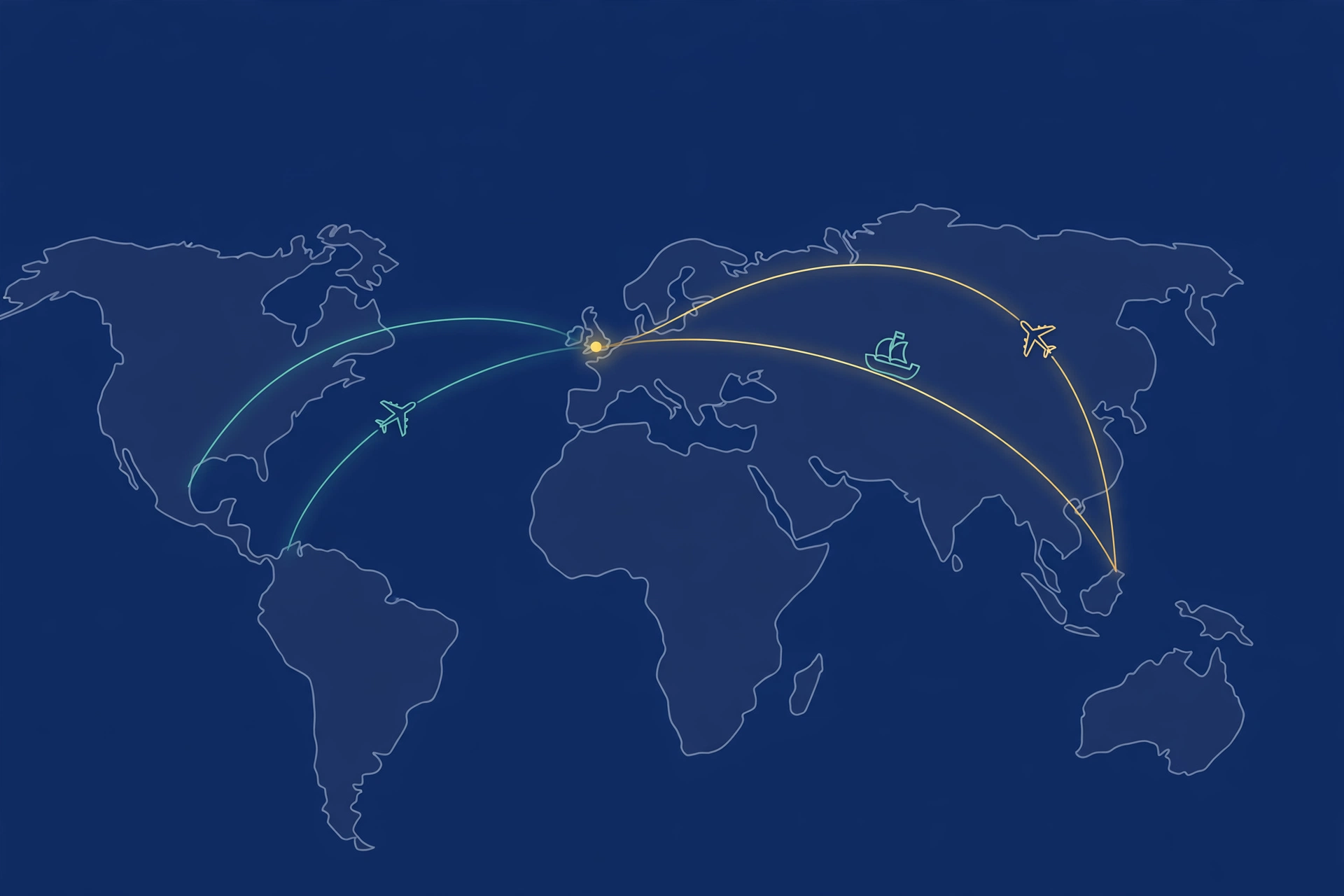
Notice what is not on the list: the customer’s country does not change the UK treatment of exported goods. Since Brexit, a parcel to Paris is an export in exactly the same way as a parcel to New York — the old “dispatch to the EU” language is dead, and any guide still using it is describing a system that ended on 1 January 2021. What the destination does change is what happens at the other end: import VAT and possibly customs duty in the buyer’s country, which is their cost unless you have agreed to cover it.
Exporting goods: the zero-rating conditions in full
HMRC’s rulebook for exported goods is VAT Notice 703, last updated on 4 March 2026. It covers supplies made from Great Britain to destinations outside the UK, and from Northern Ireland to destinations outside the UK and outside the EU. The conditions are strict, and they are cumulative — miss one and the zero-rating fails.
Direct or indirect? A direct export is one where you, the supplier, send the goods or arrange the transport to a destination outside the UK. An indirect export is one where the overseas customer, or their agent, collects the goods in the UK and arranges the export themselves. Both can be zero-rated, but indirect exports carry stricter evidence requirements — and HMRC clarified this as recently as 2 October 2026: an overseas customer buying goods for personal use and arranging export through a freight forwarder or parcel operator can still qualify as an indirect export, but goods carried away in the buyer’s accompanied baggage cannot. Two hard exclusions to remember: goods supplied to a customer who is established in the UK cannot be zero-rated even if that customer then exports them, and the Channel Islands count as exports (they are not part of the UK for VAT purposes) while the Isle of Man counts as domestic.
The 3-month clock. The goods must be exported and valid evidence of export obtained within 3 months of the time of supply. The limit stretches to 6 months only where the goods are first processed or incorporated into other goods before export. And here is the trap most small exporters never notice: the clock starts at the time of supply, which is the earlier of the date the goods are sent (or the customer takes them away) and the date full payment is received. A customer who pays in full upfront starts your 3-month clock before the goods have even left your warehouse. If you take payment months before dispatch on a made-to-order item, diarise the deadline from the payment date, not the shipping date.
What if the goods never leave? If an overseas customer asks you to deliver to a UK address — their freight forwarder’s depot, a friend, a UK office — the goods have not left the UK as part of your supply, and you must charge UK VAT at the appropriate rate. The place of supply of goods is where the goods are located at the time of supply, not where they will eventually be used. This is the single most common “export” that is not an export at all.
Proof of export: what counts and what does not
Zero-rating is conditional on evidence. HMRC accepts two kinds, and they carry equal weight — but both must be supported by documents proving the sale itself actually happened. A booking or an invoice on its own proves nothing about the goods leaving the UK.
| Evidence type | What it is | Notes |
|---|---|---|
| Official evidence | An export declaration submitted to the Customs Declaration Service (CDS) that generates a departure confirmation — you need the Movement Reference Number (MRN) or the Declaration Unique Consignment Reference (DUCR) | CDS replaced the old CHIEF system and the National Export System in 2024. Any guide still mentioning CHIEF, the National Export System or the C88 form is out of date. |
| Commercial evidence | Authenticated transport documents — a master or house air waybill (with flight prefix, number, date and place of departure), a bill of lading or sea waybill, or a CMR note for road freight | For road freight, the CMR alone is not conclusive for an ex-works collection — you need additional evidence that the goods actually left the UK. |
| Supplementary evidence | The customer’s order, your invoice, a dispatch note, an acknowledgement of receipt, and evidence of payment | This proves the transaction took place. The transport evidence proves the goods left. You need both halves. |
The evidence must describe the goods accurately and consistently with the invoice — vague descriptions are the classic reason HMRC rejects a zero-rating claim. Keep a file per shipment: order, invoice, export declaration with departure confirmation or MRN, transport document, and payment proof. Keep it for six years. One guide in the top ten says five years in one paragraph and six in another; six is correct, and it is the figure in VAT Notice 700’s record-keeping rules.
For ex-works sales, where the overseas buyer collects the goods, protect yourself in the contract: write the evidence terms into the sale, agree in advance who will return the proof of export and by when, and take a deposit equal to the VAT at stake. Several advisers recommend charging VAT upfront and refunding it when the evidence arrives — it is the only approach that leaves you unexposed if the buyer never sends the paperwork. The same logic applies to any indirect export: until the evidence is in your hands, the risk is yours, not the buyer’s.
What happens when the proof is late
This is the section no competitor explains properly, and it is where the money is. If the goods are not exported, or the evidence is not obtained, within the time limit, you must account for VAT at the appropriate UK rate in the VAT return for the period in which the limit expires. For standard-rated goods the VAT element is one-sixth of the VAT-inclusive amount — the same divide-by-six calculation our reverse VAT calculator performs.
Take a £6,000 sale. Zero-rated, the customer pays £6,000 and you account for no VAT. If the proof never arrives, the VAT due is £6,000 ÷ 6 = £1,000, which goes into box 1 of the return for the period in which the 3 months expired. We verified the same arithmetic on the live calculator across real cases: £600 gross contains £100 of VAT, £3,600 contains £600, and £9,000 contains £1,500 — all divide-by-six, all confirmed in our test run of 17 live cases on 11 November 2026. The good news is that the position is reversible: if acceptable evidence arrives later, you may zero-rate the supply after all and adjust your VAT account in the period the evidence is received. You are not permanently punished for a late courier — but you do have to fund the VAT in the meantime, which is why the deposit habit in the previous section matters.
Exporting services: B2B and B2C follow different rules
Services do not follow the parcel — they follow the customer. The governing guidance is VAT Notice 741A, and the general rules are short enough to state in two sentences. For business-to-business services, the place of supply is where the customer belongs, so a UK business supplying consultancy, design, development or professional advice to a business in Germany or the US is making a supply outside the scope of UK VAT — the customer accounts for it under the reverse charge in their own country. For business-to-consumer services, the place of supply is where the supplier belongs, so the same consultancy sold to a private individual in Germany generally carries UK VAT at 20%, exactly as if the customer lived in Leeds.
Two widely-read guides get this backwards, and both errors would cost a reader money. One tells UK businesses that accountancy or legal services supplied to a US business on a UK contract “may be subject to UK VAT” — wrong: the B2B general rule makes the place of supply the US regardless of where the contract was signed, so the supply is outside the scope. Another tells readers that services to customers outside the EU, business or consumer, are “typically outside the scope of UK VAT” — wrong for consumers: the B2C general rule charges UK VAT at 20% unless a specific exception applies. If you sell services to private individuals abroad, do not rely on a guide that collapses B2B and B2C into one sentence.
The exceptions matter, and they are specific. Electronically supplied services sold to EU consumers — software downloads, streaming, online courses — are taxed where the consumer is, not where you are, and you report them through the EU’s non-Union One Stop Shop. The same customer-location rule applies to intangible services supplied to consumers outside the EU. Land-related services are supplied where the land is; admission to events and catering where they take place; short-term hire of transport where the vehicle is put at the customer’s disposal. For a B2B invoice, the single most important thing is evidence that the customer really is a business: get their VAT number, keep it on file, and keep whatever else supports it — their website, company registration, the contract. If you cannot show the customer was in business, HMRC’s default is the B2C treatment, and the VAT is yours to account for.
IOSS, OSS and selling to EU consumers after 1 July 2026
If you sell physical goods to consumers in the EU, two EU schemes do most of the heavy lifting. The Import One Stop Shop (IOSS) lets you collect EU VAT at checkout on goods shipped to EU consumers in consignments worth €150 or less, and report it through a single monthly return instead of registering in every country you sell to. Without it, your customer faces import VAT and handling fees at the border, and the delivery stalls. For digital services to EU consumers, the equivalent is the non-Union OSS — register in one EU member state and report all your EU B2C digital sales there.
One thing genuinely changed on 1 July 2026, and most guides have not caught up. The EU abolished its €150 customs-duty relief for low-value consignments (Council Regulation (EU) 2026/382) and replaced it with a temporary flat customs duty of €3 per item on distance sales of low-value consignments, running until 1 July 2028. Two points to keep straight: the €3 is a customs duty, not VAT — import VAT has applied from the first euro since 2021 and is separate — and the €3 is charged to the seller, importer or IOSS holder, not collected from the consumer at the door, so it comes straight out of your margin unless you price for it. IOSS itself has not gone away, and it still handles the VAT side for consignments up to €150. If you are a small seller shipping single parcels to the EU, build the €3 per item into your pricing now rather than discovering it in a customs bill later.
And a warning about the €10,000 figure you will keep meeting: the EU-wide €10,000 threshold for distance sales applies to sellers established in the EU (and, in a special form, to Northern Ireland sellers — see below). It does not apply to a Great Britain seller shipping from the UK. Your goods are exports, zero-rated for UK VAT with proof; EU import VAT is a separate event at the EU border.
Northern Ireland: the exception to the export rules
Northern Ireland sits in a different VAT geography from Great Britain, and this is the section almost every competitor skips or gets wrong. Goods moving from Northern Ireland to an EU destination are intra-EU dispatches, not exports — they follow the Northern Ireland–EU movement rules, not Notice 703. Goods moving from Northern Ireland to a non-EU destination are exports, and Notice 703 applies to them. The distinction decides which evidence, which VAT-return boxes and which registration obligations apply, so get the geography right before you invoice.
For Northern Ireland sellers supplying EU consumers, the EU’s €10,000 distance-selling threshold does apply — once total cross-border sales to EU consumers pass €10,000, the seller must charge VAT at the destination country’s rate. But the seller can continue to report and pay it through the Union OSS; per-country VAT registration is not required. One ranking guide says the seller must register for VAT in each country once the threshold is passed — that is wrong, and following it would mean a pile of unnecessary foreign registrations. Intrastat, for completeness, covers dispatches and arrivals between Northern Ireland and the EU only; an NI export to a non-EU destination goes on a CDS export declaration, not Intrastat.
The threshold trap: your export sales still count towards £90,000
Here is the trap that catches successful exporters. Zero-rated export sales count in full towards the £90,000 VAT registration threshold. Outside-scope B2B services do not. Work it through with real numbers.
Imagine you sell £58,000 of goods to UK customers, £24,000 of goods to customers in the US and the EU, and £12,000 of consultancy to a business client in New York. Your taxable turnover is £58,000 + £24,000 = £82,000 — below the threshold, so registration is still voluntary. The £12,000 of US consultancy is outside the scope of UK VAT and does not count. Now change one fact: sell £70,000 in the UK and £25,000 of exported goods. Taxable turnover is £95,000 — over the threshold, and you must register, even though every one of those export sales was charged at 0% and not a penny of VAT was collected on them. Registration then lets you reclaim the input VAT on your export costs, which is usually worth having, but the 20% you must start adding to your UK prices is a real commercial decision.
Two more numbers worth knowing before you plan around the threshold. First, the threshold test is a rolling 12 months, not a tax year — check it monthly, not in April. Second, if you do register, your zero-rated exports keep their treatment; registration does not make your exports taxable at 20%. What changes is your UK sales, your paperwork, and your VAT returns — which is why the decision deserves a spreadsheet, not a guess. Our VAT percentage calculator is handy for the margin arithmetic once you know which side of the line you are on.
Worked examples: real numbers from the live calculator
Every figure below was run on the live calculator at ukvatcalculator.uk on 11 November 2026 — 17 test cases in total, covering add and remove VAT at 20%, 5% and 0%, a custom 7.5% rate, decimals, zero amounts and a £95,000 case. All 17 matched hand calculation exactly.
| Situation | Calculator input | Result |
|---|---|---|
| UK sale, net £1,000 at 20% | Add 20% to £1,000 | VAT £200.00, total £1,200.00 |
| Gross price £1,200 — VAT inside? | Remove 20% from £1,200 | VAT £200.00, net £1,000.00 |
| Export sale £2,400 at 0% | Add 0% to £2,400 | VAT £0.00, total £2,400.00 |
| Evidence failed on a £6,000 sale | Remove 20% from £6,000 (divide by 6) | VAT £1,000.00 due in box 1 |
| Large export order £95,000 at 20% (if it were a UK sale) | Add 20% to £95,000 | VAT £19,000.00, total £114,000.00 |
| Small parcel £49.99 at 20% | Add 20% to £49.99 | VAT £10.00, total £59.99 |
The third row is the one that matters most for exporters: the same £2,400 order sold in the UK would carry £400 of VAT (£2,400 ÷ 6), but as a properly evidenced export it carries none — a £400 swing on a single order, which is why the proof-of-export file is worth more than the invoice it sits next to. The fourth row is the same arithmetic in reverse: the £1,000 that becomes due when evidence fails is simply the VAT that was inside the price all along. If you want to check your own figures, the gross to net VAT calculator does the divide-by-six in one step.
The video above is a real screen recording of the calculator running three of these cases — £1,000 plus 20%, £1,200 with 20% removed, and a £2,400 export at 0%.
EORI numbers, customs declarations and the buyer’s side
VAT is only half of exporting. To move goods out of the UK you need a UK Economic Operator Registration and Identification (EORI) number, and your export declaration goes through the Customs Declaration Service — the same CDS that generates the departure confirmation you need as official proof of export. If you use a freight forwarder or courier, they usually handle the declaration, but the VAT responsibility stays with you: the forwarder’s paperwork is your evidence, so check that you actually receive the departure confirmation and the MRN, and file it the same day.
On the buyer’s side, a business customer in the EU needs to be able to act as the importer — which means holding their own EU EORI number — and they pay the import VAT at their border, at their country’s rate. A consumer buyer in the EU pays import VAT too, which is exactly what IOSS exists to smooth over: collect it at checkout, and the parcel clears without a demand at the door. Agree the Incoterms in writing before you ship, because they decide who pays the freight, the duty and the import VAT — and an argument about a €3 duty on a €40 parcel is not worth losing a customer over.
Common mistakes that cost exporters real money
Most of these come straight from errors found in ranking guides while researching this article — they are live on the internet today, and people are following them.
Charging UK VAT on B2B services to the US. The place of supply is where the customer belongs. A US business client means outside the scope, not 20% — and charging it anyway makes you 20% more expensive than a competitor who knows the rule.
Treating B2C services to non-EU consumers as outside the scope. The general B2C rule is the opposite: UK VAT at 20% applies unless a specific exception (digital services, intangibles) takes you out of it.
Calling everything “exempt”. Zero-rated, exempt and outside the scope are three different treatments with different input-VAT and threshold consequences. Using the wrong word on an invoice is not a cosmetic error — it signals the wrong treatment to your customer and to HMRC.
Still citing MOSS, CHIEF or the National Export System. MOSS was withdrawn for UK businesses in 2021; CHIEF and the National Export System were retired in 2024. If your guide, your software or your forwarder still uses these names, update them — the current terms are non-Union OSS and CDS.
Delivering to a UK address and calling it an export. If the goods never leave the UK as part of your supply, charge UK VAT. The customer’s forwarding arrangements are not your export.
Counting only UK sales towards the threshold. Zero-rated exports count in full. A business doing £70,000 in the UK and £25,000 abroad is over £90,000 and must register.
Keeping proof for five years. It is six. Shred a year early and an HMRC enquiry into a zero-rated sale becomes very difficult to defend.
How exports land on your VAT return
Zero-rated exports are not invisible on your return — they are declared, at 0%. Your zero-rated export sales sit in box 6 (total value of sales and all other outputs, excluding VAT), alongside your other sales; the VAT on them is nil, so box 1 is unaffected. If you are in Northern Ireland, your dispatches of goods to the EU go in box 8 instead. If proof of export is not obtained in time, the VAT you must account for goes into box 1 in the period the time limit expires — the one-sixth calculation from the earlier section — and if the evidence turns up later, you adjust in the period you receive it. Input VAT on your export costs is reclaimed in the usual way, in box 4.
Since April 2022, all VAT-registered businesses must keep digital records and file through Making Tax Digital-compatible software, so your proof-of-export files need to live in, or alongside, that digital record-keeping — a folder of paper waybills in a drawer does not meet the standard, and it will not survive an enquiry. If you file quarterly, the return and the payment are due one calendar month and seven days after the period ends; the proof-of-export deadline and the return deadline are two different clocks, and both need diarising. For the underlying maths, the VAT formula page sets out the add, remove and reverse calculations in one place.
Frequently asked questions
Do I charge VAT on exports from the UK?
On goods, usually no — exports are zero-rated at 0% if the goods leave the UK within 3 months and you hold acceptable proof of export. On services it depends: B2B services to overseas businesses are usually outside the scope of UK VAT, while B2C services usually carry UK VAT at 20%, with digital services to EU consumers as the main exception.
Are exports zero-rated or exempt?
Zero-rated. That matters: zero-rated supplies are taxable at 0%, so you can reclaim input VAT on your costs and the sales count towards the £90,000 registration threshold. Exempt supplies are a different category entirely and block input-VAT recovery.
How long do I have to get proof of export?
Three months from the time of supply — the earlier of dispatch (or the customer taking the goods away) and full payment. The limit is six months where the goods are first processed or incorporated into other goods. If the evidence is not obtained in time, account for VAT at the UK rate in the return for that period, and re-zero-rate if the evidence arrives later.
What counts as proof of export?
Official evidence is a CDS export declaration with a departure confirmation (MRN or DUCR). Commercial evidence is authenticated transport documents — air or sea waybills, bills of lading, or a CMR note. Both must be backed by proof of the sale itself: the order, invoice, dispatch note and payment evidence. Keep the file for six years.
Do export sales count towards the VAT registration threshold?
Yes, if they are zero-rated — zero-rated supplies are taxable supplies and count in full towards the £90,000 threshold. Outside-scope B2B services do not count. A business with £70,000 of UK sales and £25,000 of exports is at £95,000 and must register.
What is IOSS?
The Import One Stop Shop is the EU scheme that lets non-EU sellers collect EU VAT at checkout on goods sold to EU consumers in consignments worth €150 or less, reporting it through a single monthly return. It covers VAT only — since 1 July 2026 a separate temporary €3 customs duty per item applies to low-value consignments until 1 July 2028.
Do I need an EORI number to export?
Yes, for goods — you need a UK EORI number to move goods out of the UK, and your EU business customers need to be able to act as importer on their side. Your export declaration goes through the Customs Declaration Service (CDS).
VAT on exports rewards the business that keeps its paperwork straight: the goods leave, the evidence comes back, the file is kept for six years, and the 0% rate does the rest. The businesses that pay for getting it wrong are the ones who trusted a stale guide, delivered to a UK address, or let the 3-month clock run out with nothing in the file. Check your own numbers on the free UK VAT calculator before you invoice, and the export side of your VAT return will look after itself.
Figures checked against gov.uk on 11 November 2026, including HMRC VAT Notice 703 (updated 4 March 2026) and VAT Notice 741A. This article is general guidance, not tax advice — if your situation is unusual, speak to an accountant before you act.