VAT on Food: 2026 UK Guide — Free Calculator
VAT on food is the question that catches out shoppers, café owners and caterers alike — because the answer is never just “20%” or “0%”. Most food you buy in a supermarket carries no VAT at all. The same sandwich, eaten at a table inside the café that sold it, carries 20%. A milkshake is zero-rated, while the sports drink next to it in the chiller is standard-rated. And a hot pasty can be either, depending on whether it was kept warm under a heat lamp or simply left to cool in a paper bag.
This guide explains VAT on food in the UK in plain English, with every rule checked against HMRC’s own guidance on GOV.UK — VAT Notice 701/14 (food products) and VAT Notice 709/1 (catering and takeaway food). Where a popular guide states a rule wrongly, we quote it and correct it, because several of the best-known pages on this topic get the milkshake rule, the hot-food rule and the nuts rule wrong. All the worked examples use real numbers checked on the live VAT calculator on this site, so you can check any food price yourself in seconds.
The short version: as of November 2026, food VAT in the UK is either 0% (zero-rated) or 20% (standard-rated). No food is charged at 5% right now — the temporary cuts have all ended, as we explain in the history section below. Which of the two rates applies depends on three questions: what the food is, whether it is hot, and where it is eaten.
VAT on food: the basic rule — most food is zero-rated
The starting point in UK VAT law is generous: most food of a kind used for human consumption is zero-rated. That is the rule in Schedule 8, Group 1 of the VAT Act 1994, and it is why a weekly supermarket shop carries far less VAT than most people assume. Bread, milk, eggs, fresh meat and fish, fruit and vegetables, pasta, rice, tea and coffee for home use, butter, cheese — all zero-rated. When a business sells zero-rated food it charges no VAT, but it can still reclaim the VAT on its own purchases, which is what makes zero-rating different from exemption (a distinction several guides blur — see below).
Then there is a closed list of excepted items that are always standard-rated at 20%, however and wherever they are sold. And on top of that, any food supplied as catering — eaten on the premises, or delivered ready to eat — is standard-rated at 20% even if the same food would be zero-rated in a shop. Those two layers — the excepted-items list and the catering rule — are where nearly every mistake happens.
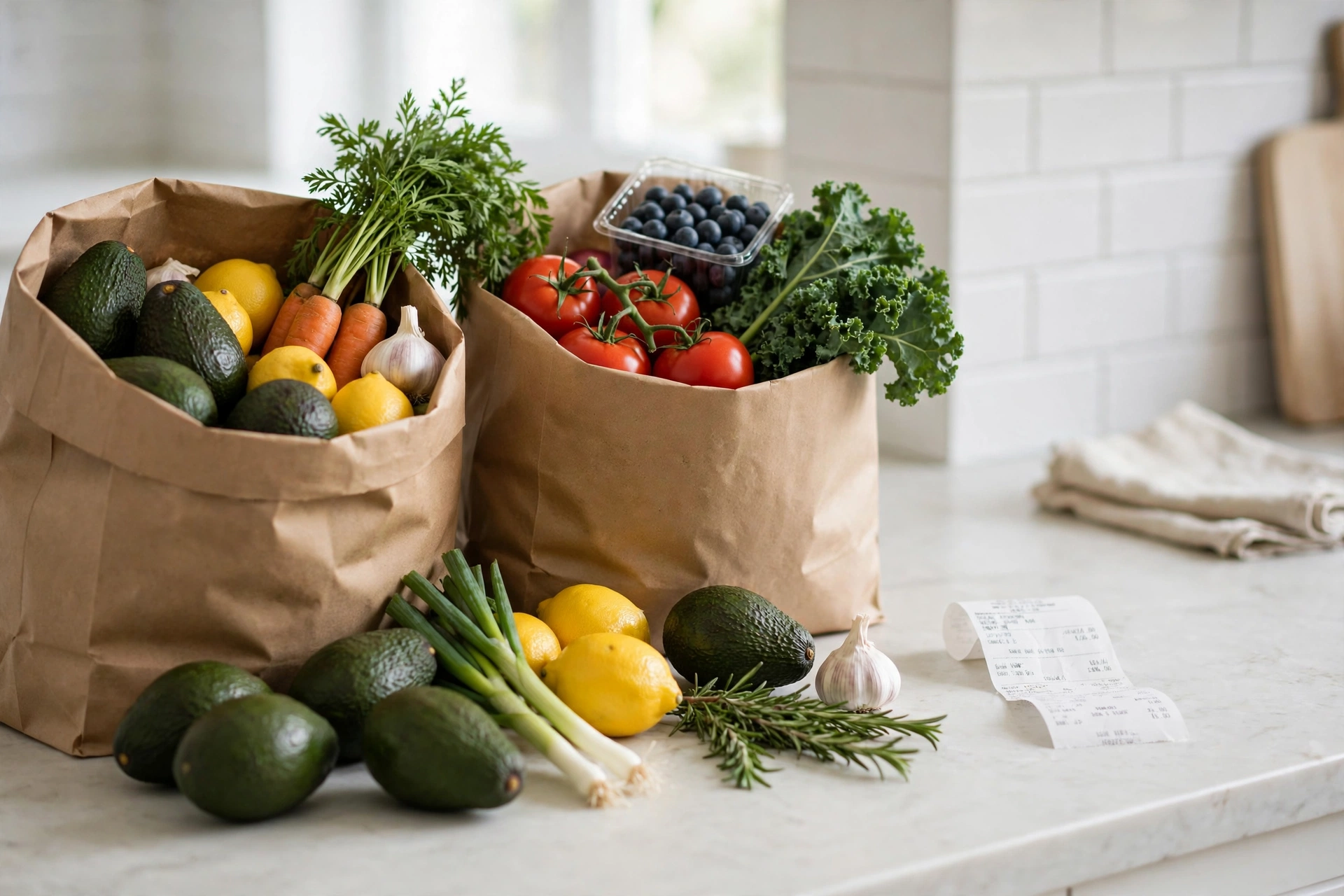
For a shopper, the practical effect is visible on any supermarket receipt. A £120 weekly shop might contain only £25 of VAT-bearing goods — wine, soft drinks, crisps and ice cream — and the VAT inside that £25 is £4.17 (the VAT fraction of a 20% price is one-sixth: £25 ÷ 6 = £4.17). The other £95 of the shop carries no VAT at all. We show the full working for this example in the worked-examples section, using the same divide-by-six arithmetic the live calculator confirmed on a £60 restaurant bill and a £12 takeaway.
What is always 20%: the excepted-items list
HMRC’s Notice 701/14 lists the food and drink that is excepted from zero-rating. These items are standard-rated at 20% in every setting — supermarket shelf, café counter, or vending machine:
| Item | VAT rate | The detail that catches people out |
|---|---|---|
| Confectionery (sweets, chocolate, chocolate biscuits) | 20% | Cakes are not confectionery — they are zero-rated even with chocolate on top. Chocolate-covered biscuits are 20%. |
| Ice cream, ice lollies, sorbets | 20% | Frozen yoghurt designed to be thawed before eating is zero-rated — an exception two rival guides omit entirely. |
| Potato crisps and similar savoury snacks | 20% | Tortilla chips and corn chips are zero-rated. Popping corn is zero-rated. Roasted or salted nuts are 20%; raw shelled nuts are 0%. |
| Soft drinks, fruit juice, squash, bottled water, carbonated drinks | 20% | Milk, milkshakes, tea, coffee and cocoa are zero-rated — milkshakes are the most commonly mis-stated item in rival guides. |
| Alcoholic drinks | 20% | Alcohol was never included in the temporary 5% hospitality cut. |
| Sports and energy drinks (including milk-based ones) | 20% | Standard-rated since 1 October 2012 — even whey-based drinks. A milkshake is 0%; a milk-based sports drink is 20%. |
| Pet food | 20% | Pet food is not food “for human consumption”, so it never qualifies for zero-rating. |
| Dietary supplements, vitamins, appetite suppressants | 20% | Supplements are not food for VAT purposes, even when sold in a health-food shop. |
| Home-brewing and wine-making products | 20% | Kits, yeasts and ingredients sold for making alcohol at home. |
Notice what is not on that list: ordinary bread, sandwiches made to take away cold, fresh fruit, vegetables, meat, fish, eggs, milk, cheese, butter, pasta, rice, breakfast cereals, flour, sugar, cooking oil, herbs and spices. All zero-rated. That is why the VAT on a typical grocery shop is so small — and why a café’s VAT bill is so much bigger than a grocer’s on the same turnover.
Cakes are 0%, chocolate biscuits are 20%: the Jaffa Cake rule
The most famous food-VAT dispute in British legal history is the Jaffa Cake case, and it still decides how biscuits and cakes are taxed today. In 1991, United Biscuits argued before a VAT tribunal that Jaffa Cakes are cakes — and therefore zero-rated — while HMRC said they were chocolate-covered biscuits, which are standard-rated. The tribunal sided with the biscuit maker, after considering, among other things, that a Jaffa Cake goes hard when stale like a cake, not soft like a biscuit. Jaffa Cakes have been zero-rated ever since.
The rule that follows from the case, set out in Notice 701/14, is simple once you know it:
- Cakes are zero-rated — even when they are sweetened, iced, or have chocolate on top. A chocolate-topped cake is still a cake.
- Biscuits wholly or partly covered in chocolate are standard-rated at 20%. Chocolate chips baked into the dough do not count as a coating, so a chocolate-chip cookie is zero-rated; a biscuit dipped in chocolate is not.
- Bourbon-style sandwich biscuits are zero-rated (the chocolate filling is not a coating), while a gingerbread man with chocolate decoration is standard-rated unless the chocolate is no more than a couple of dots for eyes.
- Cereal bars are standard-rated unless they qualify as cakes. This is where Crunch’s guide goes wrong: it lists “some cereal bars” among usually zero-rated cold items with no qualifier. A flapjack that is genuinely a cake can be zero-rated; an ordinary cereal bar is 20%.
The same classification logic produced two more famous results. In 2009 the Court of Appeal held that Pringles are potato crisps — and therefore standard-rated — reversing an earlier tribunal decision that had treated them as zero-rated. And in May 2025 the Upper Tribunal confirmed in Walkers Snack Foods Ltd v HMRC ([2025] UKUT 155 (TCC)) that Sensations Poppadoms are standard-rated too: although they are marketed as poppadoms, they contain around 40% potato-derived ingredients and are, in the tribunal’s words, similar to potato crisps. Calling a snack a poppadom does not stop it being taxed like a crisp.
The takeaway for bakers and café owners: if you bake it and it is a cake, it is zero-rated to take away — until the customer eats it on your premises, when the catering rule takes over and it becomes 20%. The same Victoria sponge is 0% in a box and 20% on a plate at your table. That is the single most useful fact in this whole guide for anyone pricing a menu.
Drinks: the milkshake mistake two big guides make
If there is one error worth correcting loudly, it is this: there is no VAT on a milkshake. Milk and flavoured milk drinks, including milkshakes, are zero-rated under Notice 701/14, paragraph 3.7.2. A milkshake bought cold to take away is 0%.
Yet two of the most-read guides on this topic state the opposite. Crunch writes: “Most cold drinks are standard-rated, including bottled water, fizzy drinks, smoothies, and milkshakes.” Reflex Accounting writes: “Most cold drinks are also subject to the standard 20% rate, including bottled water, fizzy drinks, smoothies, milkshakes and alcohol.” Both are wrong on milkshakes. Bottled water, fizzy drinks and alcohol are indeed 20% — but a milkshake is a milk drink, and milk drinks are zero-rated.
The exception that causes the confusion is real but narrow: milk-based sports and nutrition drinks are standard-rated (since 1 October 2012, Notice 701/14 paragraph 4.6.1). So a whey protein shake is 20% while a strawberry milkshake from the same café is 0%. The difference is not the milk — it is whether the drink is marketed and sold as a sports or nutrition product.
The full drinks picture:
| Drink | VAT rate | Why |
|---|---|---|
| Milk, flavoured milk, milkshakes | 0% | Milk drinks are zero-rated (701/14, para 3.7.2) |
| Tea, maté, herbal tea, coffee, cocoa (for home) | 0% | Zero-rated as food; but a hot drink served in a café is catering — 20% |
| Soya milk, rice milk, coconut milk | 0% | Can be zero-rated as milk substitutes (701/14, para 3.7.3) |
| Soft drinks, fruit juice, squash, cordials, smoothies, bottled water | 20% | Excepted “other beverages” |
| Sports and energy drinks, including milk-based ones | 20% | Standard-rated since 1 October 2012 |
| Beer, wine, spirits, alcohol-free beer and wine | 20% | Alcoholic beverages are excepted; alcohol-free beer and wine are standard-rated too |
| Hot drinks served in a café or restaurant | 20% | Hot drinks are always catering — 20% whether eaten in or taken away |
Two more corrections belong here, both from Pleo’s guide, which is the most error-prone page in our top-10 review. Pleo claims a “50% milk rule”: that a drink containing at least 50% milk is zero-rated. There is no such rule in current HMRC guidance. Notice 701/14 lists milk drinks without any percentage test; the old 45% guide figure was described by a tribunal as “wholly arbitrary”. And Pleo states that shelled nuts are standard-rated with peanuts as the exception — also wrong, as the next section explains.
Savoury snacks: crisps, nuts, tortilla chips and popcorn
The savoury-snack rule is narrower than most guides suggest. A snack is standard-rated only if it falls into one of three categories in Notice 701/14, paragraph 3.8: (a) potato or potato-flour or potato-starch products, (b) puffed or extruded cereal snacks, or (c) roasted or salted nuts — and potato and cereal products must be packaged ready to eat. Everything else savoury is zero-rated, which produces several surprises:
- Tortilla chips and corn chips are zero-rated. Accotax’s guide lists “corn snacks” as standard-rated in its table — wrong. A bag of tortilla chips carries no VAT.
- Vegetable crisps (beetroot, carrot) are zero-rated. They are not potato products.
- Popping corn and microwave popcorn are zero-rated. Only savoury popcorn sold ready to eat is standard-rated, and sweet popcorn is standard-rated as confectionery. Freevatcalculator’s table lumps “crisps, Pringles and popcorn” together at 20% with no way to tell the difference — its own text does not rescue a reader who only scans the table.
- Raw shelled nuts are zero-rated; only roasted or salted shelled nuts are 20%. Pleo’s claim that shelled nuts are standard-rated, with peanuts as a special exception, is wrong: the rule turns on roasting and salting, not on the type of nut. A plain shelled almond is 0%; the same almond roasted and salted is 20%. Nuts in their shells are zero-rated either way, and roasted or salted nuts are standard-rated even when sold loose.
- Roasted pulses and legumes are zero-rated.
For a shop owner, the practical lesson is to check the product, not the shelf label. Two bags that look identical on a shelf can carry different VAT because one is made from potato and the other from corn — and the Sensations Poppadoms case shows HMRC will litigate the difference all the way to the Upper Tribunal.
Hot food and the five tests: when a pasty is 20% and when it is 0%
Food supplied in the course of catering is always standard-rated at 20%, and hot takeaway food is part of that rule — but with a crucial qualification that two rival guides omit. Reflex Accounting states flatly: “Hot takeaway food is always rated as 20% VAT.” MyPOS says the same: “Hot food and drinks are always subject to 20% VAT — regardless of whether they are eaten on-site or taken away.” “Always” is wrong.
Under Notice 709/1, hot takeaway food is standard-rated only if it meets two conditions. First, the precondition: the food must be above ambient air temperature when it is handed over. Second, at least one of five tests must be met:
- It was heated so that it can be eaten hot.
- It was heated to order.
- It was kept hot after heating.
- It was supplied in heat-retaining packaging, or packaging designed for hot food.
- It was advertised or marketed as supplied hot. (“Freshly baked” does not count as marketing as hot.)
Food that is merely warm because it was freshly baked, with none of the five tests met, stays zero-rated. HMRC’s own worked examples in Notice 709/1 make the point with pasties: a Cornish pasty cooling naturally in a paper bag is 0%; the same pasty held under heat lamps is 20%. A sausage roll that has just come out of the oven and is sitting on a shelf cooling down is 0% — until the baker puts it in a heated cabinet, when it becomes 20%. The 2012 “pasty tax” row was about exactly this boundary: the government’s original proposal would have taxed all hot food, and the compromise that survived is the five-test rule we still use today.
Three further points from Notice 709/1 complete the picture:
- Hot food with a cold ingredient is standard-rated as a whole. A hot dog, a hamburger, a bacon sandwich or a baked potato with a cold filling is one standard-rated supply — you do not split off the cold part.
- Mixed items sold together for one inclusive price are a mixed supply, apportioned by tax value. A meal deal is the everyday example — see the section below.
- Free condiments are ignored. The salt, pepper, vinegar and mustard on the table do not change the VAT treatment of the meal.
And one point Crunch’s guide gets wrong in its summary table: it says catering “includes food prep and delivery”. Delivery of food the customer must still prepare — cook, reheat, thaw or plate — is not catering and can be zero-rated. Only delivered ready-to-eat meals are catering at 20%.
Eating in vs taking away: where you eat changes the VAT
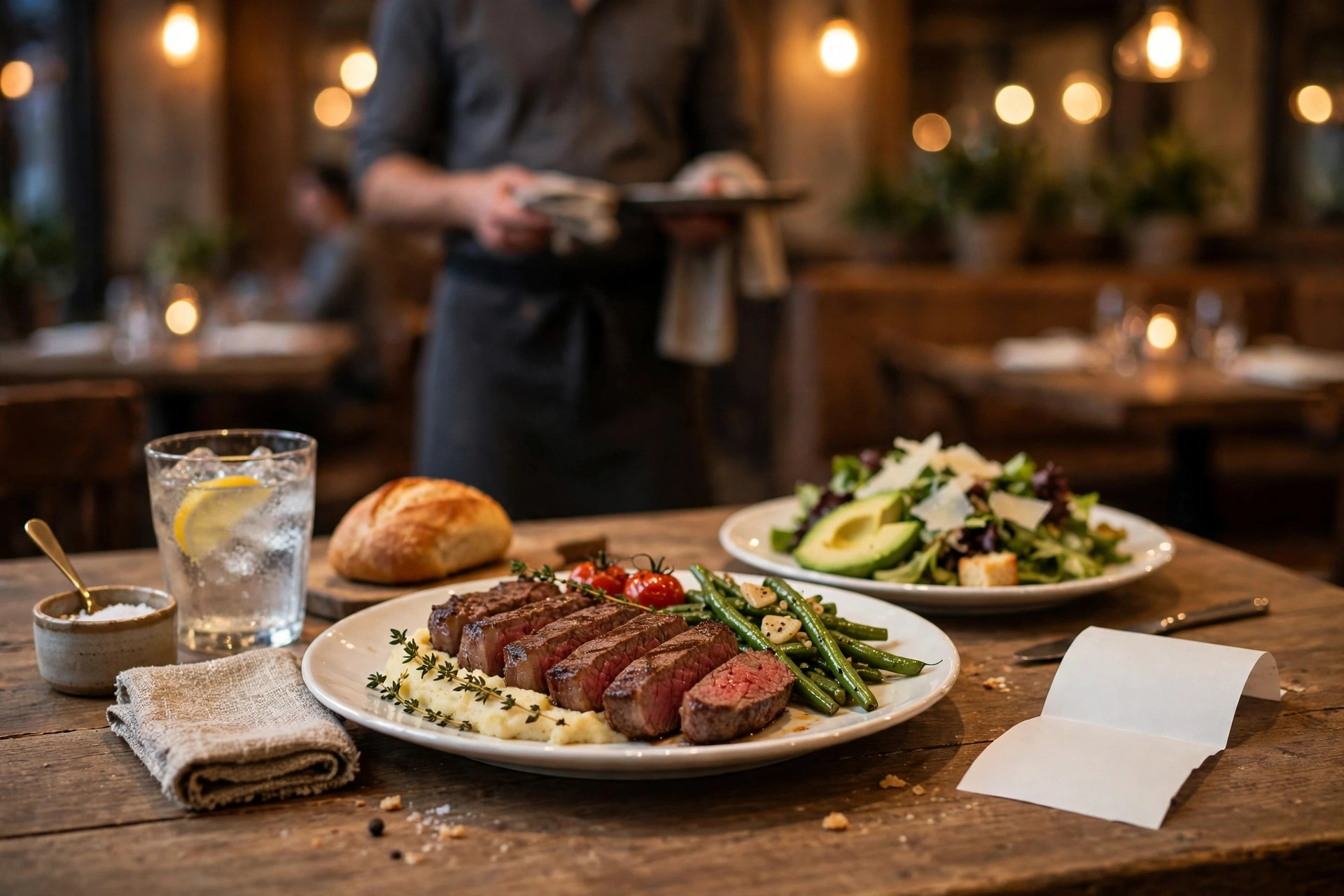
The same sandwich is taxed differently depending on where it is eaten, because eating on the premises turns a sale of food into catering. A cold sandwich bought to take away is zero-rated; the identical sandwich eaten at a table in the café is standard-rated at 20%. A cake is 0% in a box and 20% on a plate. This is the rule that makes café pricing genuinely tricky, and it turns on HMRC’s definition of “premises”.
Under Notice 709/1, “premises” means the areas occupied by the retailer plus any area set aside for customers to eat in — including pavement tables, shared food-court tables and supermarket seating areas. What does not count as premises is general public seating: shopping-centre benches, public picnic areas, and airport or railway waiting seating. So a sandwich bought in a food court and eaten at a food-court table is 20%, because the food court is a designated eating area; the same sandwich eaten on a public bench outside the shopping centre is 0%. Only SwiftVATPro mentions this distinction in passing among our competitors — it deserves a full section, because it is the question café owners actually ask when they add seating.
The table below summarises the combinations that matter in practice:
| Situation | VAT rate | Why |
|---|---|---|
| Cold sandwich, cake or salad taken away | 0% | Zero-rated food, no catering |
| Same sandwich or cake eaten at a café table | 20% | Catering on the premises |
| Same sandwich eaten on a public bench | 0% | Public seating is not premises |
| Hot meal eaten in a restaurant | 20% | Catering — always 20% |
| Hot takeaway (fish and chips, hot pizza) | 20% | Hot-food tests met |
| Cold takeaway pizza or cold chicken | 0% | Cold takeaway food, no catering |
| Hot drink in a café or to take away | 20% | Hot drinks are always catering |
| Crisps, chocolate, soft drink — anywhere | 20% | Excepted items, always 20% |
| Ready meal delivered hot, ready to eat | 20% | Delivered catering |
| Meal kit delivered for the customer to cook | 0% (usually) | Not catering — customer prepares it |
Adding seating is therefore a VAT decision, not just a furniture decision. Reflex Accounting makes this point well: the day a takeaway adds tables, its cold sandwiches move from 0% to 20% for customers who sit down. The price on the board does not change, but one-sixth of it suddenly belongs to HMRC — on a £4.50 sandwich, that is 75p. A business that does not reprice or restructure absorbs that cost out of its own margin.
Restaurants, cafés and pubs: the 20% bill, worked out
Everything eaten or drunk on restaurant, café or pub premises is standard-rated at 20%, including the bread roll, the still water and the service charge added to the bill. That last point matters: a service charge added to the bill carries VAT at 20%, while a freely given tip above the total charge has no VAT at all (Notice 709/1, paragraph 2.3). The distinction is whether the charge is part of the price or a voluntary extra.
Take a £60 restaurant bill. The VAT inside it is £10.00 and the net amount is £50.00 — we checked this on the live calculator (gross £60, remove 20%: VAT £10.00, net £50.00). The shortcut is the divide-by-six rule: the VAT inside any 20% VAT-inclusive price is the price divided by six. £60 ÷ 6 = £10. It works because 20% VAT on a net price of £50 is £10, and £50 + £10 = £60 — so the VAT is always one-sixth of the gross. Use the reverse VAT calculator for any bill, or the add or remove VAT calculator when you are building a price from a net figure.
The same arithmetic explains why a café’s till total and its VAT return rarely match in a simple way. A café that takes £10,000 in a quarter, all of it eaten in, owes £1,666.67 of output VAT (£10,000 ÷ 6) — but a café that sells the same £10,000 mostly as cold takeaway owes far less, because most of its sales are zero-rated. That is why the split between eat-in and takeaway, and between zero-rated and standard-rated items, has to be recorded properly — either at the till (point of sale) or through one of HMRC’s retail schemes (Notice 727), which let a business apportion its takings instead of tracking every item. SwiftVATPro is the only competitor that covers retail schemes and the VAT return boxes with a worked quarterly example; we cover both in the business section below.
Takeaways and deliveries
Takeaway food follows the same three questions as everything else: what is it, is it hot, and where is it eaten? A cold sandwich, a cold pizza or a salad box taken away is zero-rated. A hot pizza, hot fish and chips or a hot curry taken away is standard-rated, because the hot-food tests are met. A hot drink taken away is standard-rated, because hot drinks are always catering. A soft drink or a bag of crisps added to the order is standard-rated wherever it goes.
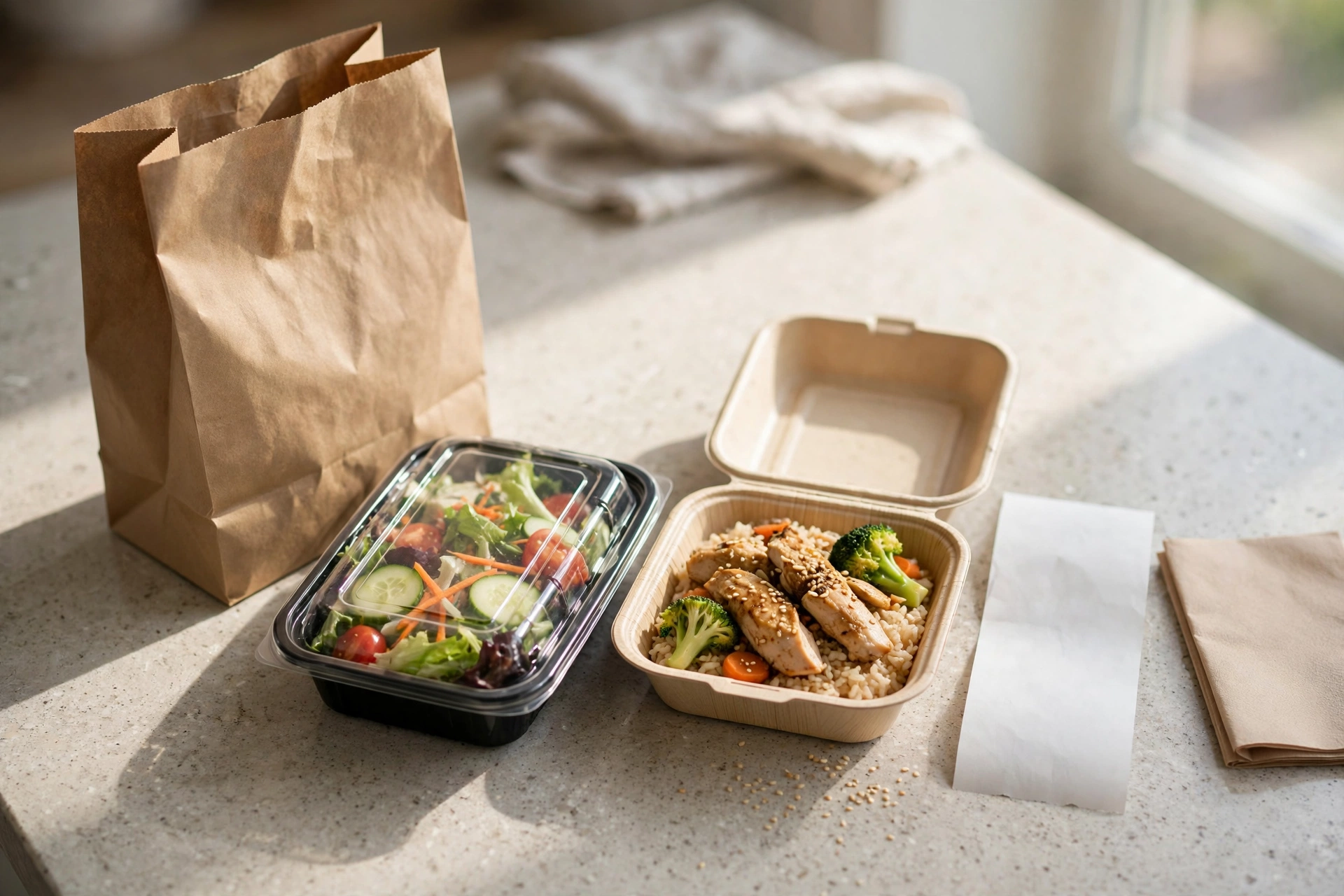
Delivery does not change the answer by itself. A ready-to-eat meal delivered hot is catering at 20%, just as it would be in the restaurant. But a delivery of food the customer must still prepare — a meal kit, a frozen pizza, a cook-at-home box — is not catering and can be zero-rated, as Notice 709/1, paragraph 2.2.1 confirms. The Subway case from 2014 is the cautionary tale here: toasted sandwiches, heated so they could be eaten hot, were held to be standard-rated hot food even though the customer took them away. Heat them to order and they are 20%; sell the same sandwich cold and it is 0%.
For the customer, the practical check is the receipt. A £12 hot takeaway order contains £2.00 of VAT and £10.00 of food (checked on the live calculator: gross £12, remove 20% → VAT £2.00, net £10.00). A £24.99 food-delivery order contains £4.16 of VAT and £20.82 of food as the calculator returns it — note the figures add to £24.98, not £24.99, because both numbers sit exactly on a half-penny and the calculator rounds both down. That 1p rounding difference is normal; it is not an error in the bill, and it is the reason till systems and VAT returns occasionally differ by a penny.
Meal deals and mixed supplies
A meal deal is a mixed supply: one price for items that carry different VAT rates. The rule is to apportion the price by the normal selling prices of the items, then apply 20% to the standard-rated share and 0% to the zero-rated share.
Take a £5 meal deal: a sandwich that normally sells for £3.50 (zero-rated), a soft drink that normally sells for £1.00 (standard-rated) and a bag of crisps that normally sells for £0.50 (standard-rated). The standard-rated share is £1.50, and the VAT inside it is £1.50 ÷ 6 = £0.25. So the deal contains 25p of VAT, and the business accounts for 25p of output tax on that £5 sale. The same method applies to any bundle — a picnic hamper, a breakfast deal, a children’s meal with a drink and a toy (the toy, if separately priced and worth more than the linked-goods limits, is its own supply).
There is also a small concession worth knowing, still stated in the live Notice 701/14 (paragraphs 6.1–6.2) as read on 16 November 2026: a minor standard-rated item supplied with a main zero-rated item can be treated as a single zero-rated supply if it is not separately priced, costs no more than 20% of the total cost and no more than £1 excluding VAT. One rival calculator claims HMRC withdrew this concession in January 2026, but the live notice still states it, so we do not repeat the withdrawal claim. Similar allowances exist for biscuit assortments (standard-rated chocolate biscuits up to 15% of net weight) and fruit-and-nut mixes (standard-rated items up to 25% of net weight).
How to check any food item in five questions
Freevatcalculator’s interactive checker does this job with software; the same logic works on paper, and it is the fastest way to answer “is there VAT on this?” for any item:
- Is it food for human consumption? If not — pet food, supplements, home-brewing kits — it is 20%.
- Is it an excepted item? Confectionery, crisps, ice cream, soft drinks, bottled water, alcohol, sports drinks — if yes, it is 20% wherever it is sold.
- Is it hot under the five tests? Above ambient temperature when handed over, plus one of the five tests (heated to be eaten hot, heated to order, kept hot, heat-retaining packaging, advertised as hot). If yes, it is 20%.
- Is it eaten on the premises, or supplied as catering? If yes — including a food-court table — it is 20%.
- Otherwise, it is zero-rated. Cold food taken away, groceries, a cake in a box: 0%.
Work through a few examples and the logic becomes automatic. A bottle of water: food, but an excepted item — 20%. A milkshake: food, not excepted, cold, taken away — 0%. A sausage roll eaten on a public bench: food, not excepted, merely warm from baking with no test met, eaten off the premises — 0%. The same sausage roll under a heat lamp: 20%. A coffee bought as beans: 0%. The same coffee served hot in a cup: 20%.
Worked examples: the VAT inside real food prices
Every figure in this section was checked on the live calculator at ukvatcalculator.uk on 16 November 2026 — 15 test cases in total, documented in the test record for this article. The method for a VAT-inclusive price is always the same: divide the gross price by 6 to find the VAT at 20%, and subtract it to find the net amount. For a VAT-exclusive price, multiply the net by 20% and add it on. The VAT formula page on this site sets out both directions, and the gross-to-net VAT calculator does the remove-VAT half in one step. To check what percentage of a price is VAT, use the VAT percentage calculator.
Example 1 — a £60 restaurant bill. Gross £60, remove 20%: VAT £10.00, net £50.00. One-sixth of the bill goes to HMRC. This is the number to remember when a customer asks why the bill is what it is, or when you are checking a restaurant receipt.
Example 2 — a £12 hot takeaway. Gross £12, remove 20%: VAT £2.00, net £10.00. The same £12 spent on cold takeaway sandwiches would carry no VAT at all.
Example 3 — a £24.99 food-delivery order. Gross £24.99, remove 20%: the calculator returns VAT £4.16 and net £20.82. These are the calculator’s real figures, and they add to £24.98 — 1p short of the bill — because both values sit exactly on a half-penny and the calculator rounds both down. If you work it out by hand you might expect £4.17 and £20.83; the 1p difference is a rounding effect, not a mistake, and it is worth knowing about before you chase a penny through a VAT return.
Example 4 — a catering quote. A caterer quotes £45 before VAT for a buffet. Add 20%: VAT £9.00, total £54.00. Quote the gross figure to the customer, or the £9 of VAT becomes a surprise.
Example 5 — a café order, takeaway vs eaten in. Coffee £3.20, sandwich £4.50, slice of cake £2.80 — total £10.50. Taken away, only the hot coffee carries VAT: £3.20 ÷ 6 = £0.53. Eaten in, the whole order is catering: £10.50 ÷ 6 = £1.75. Same food, same price, £1.22 more VAT because the customer sat down. (Freevatcalculator’s own worked café example reaches £1.75 eaten in as well, on a £10.50 order — the arithmetic agrees even where our guides disagree on the rules.)
Example 6 — a weekly supermarket shop. A £120 shop in which £25 of goods are standard-rated (wine £12, soft drinks £6, crisps £3, ice cream £4): the VAT is £25 ÷ 6 = £4.17, and the other £95 carries no VAT. Groceries at 0% are confirmed by the calculator too: £80 net at 0% gives VAT £0.00 and a total of £80.00, and a £150 gross zero-rated bill gives VAT £0.00 and a net of £150.00.
Example 7 — a large catering contract. Net £25,000 at 20%: VAT £5,000.00, total £30,000.00. On contracts of this size, quoting net or gross wrongly is a £5,000 mistake.
Example 8 — small and decimal amounts. A net £8.40 café item at 20% gives VAT £1.68 and a total of £10.08. A net £37.49 item gives VAT £7.50 and a total of £44.99. A gross £99.99 bill gives VAT £16.66 and a net of £83.33 — which, unlike the £24.99 case, sums exactly to the gross. Rounding goes both ways; the calculator’s figures are the ones to use.
Example 9 — the 5% rate, for the history books. When food was temporarily charged at 5% (see the history section), a gross £105 bill contained £5.00 of VAT and £100.00 net, and a net £200 catering order at 5% carried £10.00 of VAT for a £210.00 total. No food is charged at 5% today, but these figures show the 5% fraction: the VAT inside a 5% price is the price divided by 21.
The 5% rate: a short history, and why no food is 5% today
Ask “is food 5% VAT?” and the honest answer is: it was, twice, and it is not now. The confusion is understandable, because the 5% rate has come and gone three times in six years, and several guides still carry stale dates. Here is the timeline in one place — the section no competitor assembles completely.
- 15 July 2020 – 30 September 2021: 5%. The COVID hospitality cut applied 5% to food and non-alcoholic drinks supplied for consumption on the premises, and to hot takeaway food and drink. Alcohol was never included.
- 1 October 2021 – 31 March 2022: 12.5%. The temporary rate stepped up to 12.5% before expiring. Several guides get this wrong: myPOS describes the period as “5% between 15 July 2020 and 31 March 2022”, and Pleo says 20% returned “in March 2022”. In fact 5% ended on 30 September 2021, 12.5% ran to 31 March 2022, and 20% returned on 1 April 2022.
- 25 June – 1 September 2026: 5% on children’s meals. A second, smaller cut applied 5% to qualifying children’s meals — from a children’s menu, eaten on the premises in a restaurant, pub or café, for under-18s — under HMRC Revenue and Customs Brief 5 (2026). Takeaways did not qualify. It ended on 1 September 2026, and food returned to 20% from 2 September 2026. Only freevatcalculator and Accotax cover this cut among our competitors; the rest either predate it or omit it.
- 28 October 2026: Autumn Budget — no hospitality cut. The hospitality industry campaigned for a permanent 10% rate under the #VATsTheProblem banner, backed by a petition of more than 400,000 signatures, but the Autumn Budget delivered on 28 October 2026 left hospitality VAT at 20%. Business-rates relief moved instead; VAT did not. Plan any 2027 budget on 20%.
The bottom line for November 2026: food VAT is 0% or 20% only. If a till, a menu or a supplier invoice shows 5% on food today, it is wrong — check it before you file.
Zero-rated is not exempt: a distinction worth £90,000
Several guides use “exempt” and “zero-rated” as if they meant the same thing. They do not, and the difference is worth real money. Pleo’s guide states: “Takeaway food is only exempt from VAT if it’s served cold.” That is wrong twice over: cold takeaway food is zero-rated, not exempt — and Pleo itself says so correctly elsewhere on the same page.
Zero-rated sales count towards the £90,000 VAT registration threshold, and a business making zero-rated sales can still reclaim the VAT on its purchases. Exempt sales do neither: they do not count towards the threshold, and they block input-VAT recovery. A grocer selling £100,000 of zero-rated food must register for VAT (and can reclaim the VAT on its fridges, vans and electricity). A business making only exempt sales does not register on those sales at all, but cannot reclaim its input VAT either. Confusing the two words can lead a business to miss registration entirely — or to reclaim VAT it is not entitled to.
Food that is genuinely exempt is rare: catering supplied by an institution providing exempt education to its own pupils, and food supplied directly to hospital patients as part of their care, are the main examples — and even there, the contractor caveat in the next section applies.
For food businesses: registration, the Flat Rate Scheme trap, and the VAT return
For a café, takeaway or caterer, the food-VAT rules feed directly into three business decisions: whether to register, which scheme to use, and how to fill in the return.
Registration. You must register for VAT when your taxable turnover passes £90,000 in a rolling 12-month period (since 1 April 2024 — it was £85,000 before that), or when you expect it to pass £90,000 in the next 30 days alone. Zero-rated sales count towards that £90,000, which is why a busy grocer or bakery can be forced to register even though it charges no VAT on most of what it sells. You can also register voluntarily below the threshold — and for a food business that buys a lot of standard-rated stock and equipment, that is often the right move, because registration unlocks input-VAT recovery. You deregister when turnover falls below £88,000. Our guide to how to register for VAT covers the process step by step, and our guide to how to claim VAT back explains input tax in full.
The Flat Rate Scheme trap. The Flat Rate Scheme lets a small business pay VAT as a fixed percentage of its turnover instead of accounting for VAT on every sale: 12.5% for catering, 6.5% for pubs, 4% for retailing food, with a 1% discount in the first year of registration, a £150,000 joining limit and a £230,000 exit threshold. It sounds simple, and for a mostly standard-rated caterer it can be. But for a business whose sales are mostly zero-rated — a bakery selling cold cakes to take away, a grocer, a sandwich shop with mostly takeaway trade — it is a trap: you pay 12.5% or 4% on takings that include sales on which you charged no VAT at all. Take a takeaway with £100,000 of turnover, £80,000 of it zero-rated cold food and £20,000 standard-rated: on the standard scheme it owes roughly £3,333 of output VAT (£20,000 ÷ 6) less its input tax; on the Flat Rate Scheme at 12.5% it pays £12,500. Only freevatcalculator and SwiftVATPro cover this properly among our competitors — the rest do not mention it, or give only the joining limit. Our guide to the Flat Rate Scheme works through the comparison in detail.
Retail schemes and the VAT return boxes. A café that cannot track every item at the till can use one of HMRC’s retail schemes (Notice 727) — point of sale, apportionment, or direct calculation — with a catering adaptation for caterers under £1 million of catering sales. Whichever method you use, the return boxes work the same way: Box 1 is the output VAT on your sales, Box 4 is the input VAT you reclaim, Box 6 is the total value of your sales excluding VAT, and Box 7 is the total value of your purchases excluding VAT. SwiftVATPro’s worked café quarter is a good model: £10,000 of takings, all eaten in, gives Box 1 of £1,666.67 (£10,000 ÷ 6) and Box 6 of £8,333.33. Our guides to the Cash Accounting Scheme and the Annual Accounting Scheme cover the other schemes a food business might use, and everything is filed through Making Tax Digital-compatible software.
Correcting mistakes. If you get a food-VAT rate wrong, the correction rules are forgiving for small errors: net errors up to £10,000 can be corrected on your next return, and errors up to £50,000 can be corrected the same way if they are no more than 1% of your Box 6 figure. Larger errors need a separate disclosure to HMRC. Only freevatcalculator mentions these thresholds among our competitors — but they are the numbers that decide whether a mis-priced menu is a quiet fix or a formal disclosure.
Service charges, tips, staff meals and vending machines
A cluster of smaller rules from Notice 709/1 is worth knowing, because they come up in real cafés and restaurants every week:
- Service charge vs tip. A service charge added to the bill is part of the price and carries 20% VAT. A freely given tip above the total charge has no VAT. The difference is whether the customer had a choice.
- Free meals for customers or friends are business entertainment: no input tax recovery on the cost. Free meals for staff carry no VAT charge.
- Vending machines in canteens and restaurant areas are standard-rated; machines in thoroughfares follow the VAT treatment of the product itself. A cold sandwich from a machine in a corridor is 0%; the same sandwich from a machine in a canteen is 20%.
- Business expenses. A business can reclaim the VAT on subsistence — food and drink bought while travelling on business — with a valid VAT receipt. Entertaining clients is blocked: no input-tax recovery at all. Staff entertaining is reclaimable. This is the one area where Crunch’s guide is genuinely better than the rest, and it is worth reading alongside the food rules.
Schools and hospitals: the contractor caveat one guide gets wrong
School and hospital catering has its own exceptions, and one competitor states them wrongly. Accfirm’s guide says: “School meals provided during normal school hours are exempt from VAT.” That is oversimplified to the point of being wrong. The actual position under Notice 709/1 is:
- Catering supplied by an institution providing exempt education to its own pupils or students is also exempt.
- Local-authority school catering supplied at or below cost is non-business, so no VAT is due.
- But catering supplied by a contractor acting as principal is standard-rated at 20%. If a private caterer runs the school kitchen as its own business, the meals it supplies are standard-rated — they are not exempt just because the customer is a school.
- Hospital food supplied directly to patients as part of their care is exempt; catering to staff and visitors is not.
For a catering company bidding for a school or hospital contract, that contractor caveat is a 20% swing on the whole contract value. Check who is acting as principal before you price the bid.
Importing food: the VAT follows the UK rate
Food imported into the UK is treated the same way as domestic sales for VAT purposes — which is to say, the import VAT follows the UK rate for that food. Zero-rated food generally comes in free of import VAT; standard-rated food carries 20% import VAT. That is the whole of it, and it is worth stating plainly because Accotax’s guide covers imported food in a single vague sentence (“treated the same way as domestic sales”) with no mention of import VAT, customs duty, or the post-Brexit rules that now apply.
For a food business importing ingredients or finished goods, the practical points are: use postponed VAT accounting where available so import VAT is declared on the VAT return rather than paid at the border; keep the C79 import VAT certificate as evidence; and remember that the zero-rating of the goods does not remove customs duty where duty applies — VAT and duty are separate taxes. Our guide to VAT on imports covers the process, and the reverse charge guide covers the related rules for services bought from overseas suppliers. Food imported for a business that is not VAT-registered cannot be reclaimed, and the import VAT becomes part of the cost.
What the other guides get wrong: the corrections in one place
We read the ten highest-ranking pages on this topic in full, including HMRC’s own notices, and checked every claim against Notices 701/14 and 709/1. The table below is the result — the errors we found, who made them, and the correct rule. If you have been following another guide’s advice on any of these points, change it.
| The error | Who says it | The correct rule |
|---|---|---|
| “Milkshakes are standard-rated” | Crunch, Reflex | Milkshakes are zero-rated milk drinks (701/14, para 3.7.2). Only milk-based sports drinks are 20%. |
| “Hot takeaway food is always 20%” | Reflex, myPOS | Only if above ambient temperature and one of the five tests is met; freshly baked food cooling naturally is 0% (709/1, para 4.4). |
| “Takeaway food is only exempt if served cold” | Pleo | Cold takeaway food is zero-rated, not exempt — different threshold and input-VAT consequences. |
| “The 50% milk rule” for milk drinks | Pleo | No fixed percentage exists in current HMRC guidance; the old 45% guide was called “wholly arbitrary” by a tribunal. |
| “Shelled nuts are standard-rated” | Pleo | Only roasted or salted shelled nuts are 20%; raw shelled nuts are 0% (701/14, paras 3.1, 3.8). |
| “Corn snacks are standard-rated” | Accotax | Tortilla and corn chips are zero-rated (701/14, para 3.8). |
| “Cereal bars are zero-rated” / “sweetened baked goods” are excepted | Crunch | Cereal bars are 20% unless they qualify as cakes; cakes are 0% even sweetened or iced (701/14, para 3.6). |
| “Frozen yoghurt is 20%” (stated absolutely) | Accotax, Accfirm | Frozen yoghurt designed to be thawed before eating is zero-rated (701/14, paras 2.2, 3.5). |
| “School meals are exempt” (no caveat) | Accfirm | Catering by a contractor acting as principal is standard-rated (709/1, para 2.6). |
| COVID 5% “15 July 2020 – 31 March 2022” | myPOS | 5% ended 30 September 2021; 12.5% ran 1 October 2021 – 31 March 2022; 20% returned 1 April 2022. |
| “Cold beverages are generally zero-rated” | SwiftVATPro | Most cold drinks are 20%; only milk, tea, coffee and cocoa preparations are 0% (701/14, para 3.7.2). |
| “Linked-goods concession withdrawn January 2026” | freevatcalculator | The live Notice 701/14, paras 6.1–6.2, still states the concession as read on 16 November 2026. |
The pattern is worth noting: the errors cluster around the same few items — milkshakes, hot food, nuts, frozen yoghurt — and they are repeated from guide to guide. When a claim appears in more than one guide, check it against the HMRC notice, not against the other guides. The authoritative sources for everything in this article are HMRC’s VAT Notice 701/14 on food products and VAT Notice 709/1 on catering and takeaway food on GOV.UK.
Frequently asked questions
Is there VAT on food in the UK?
Yes and no: most food is zero-rated at 0%, while excepted items (confectionery, crisps, ice cream, soft drinks, alcohol) and all catering are standard-rated at 20%. As of November 2026 no food is charged at 5% — the temporary cuts have all ended.
Is there VAT on a milkshake?
No. Milk and flavoured milk drinks, including milkshakes, are zero-rated under HMRC Notice 701/14. The exception is milk-based sports and nutrition drinks, which are standard-rated at 20%.
Is there VAT on takeaway food?
It depends. Cold takeaway food is usually zero-rated, hot takeaway food is usually standard-rated at 20% if it is above ambient temperature and meets one of HMRC’s five hot-food tests, and excepted items such as soft drinks and crisps are 20% either way.
Is there VAT on food eaten in a restaurant?
Yes — everything eaten or drunk on restaurant, café or pub premises is standard-rated at 20%, because it is catering. The VAT inside a £60 restaurant bill is £10.00, which is one-sixth of the bill.
What is the VAT on a sandwich?
A cold sandwich taken away is zero-rated at 0%. The same sandwich eaten at a table in the café is standard-rated at 20%, and a hot sandwich such as a toasted sub is 20% either way.
Is there VAT on cakes and biscuits?
Cakes are zero-rated, even when sweetened, iced or topped with chocolate — Jaffa Cakes were held to be cakes in 1991. Biscuits wholly or partly covered in chocolate are standard-rated at 20%. Cereal bars are 20% unless they qualify as cakes.
Do I need to register for VAT if I sell food?
You must register when your taxable turnover passes £90,000 in a rolling 12-month period, and zero-rated food sales count towards that threshold. You can also register voluntarily below the threshold, which lets you reclaim the VAT on your business purchases.
The bottom line
VAT on food comes down to three questions: what is it, is it hot, and where is it eaten? Most food is zero-rated; the excepted items and all catering are 20%; and nothing is 5% right now. A milkshake is 0%, a sports drink is 20%, a cake in a box is 0% and the same cake on a plate is 20%, and a pasty cooling in a paper bag is 0% until it goes under a heat lamp. Check any food price with the free calculator on this site — divide a 20% price by six to find the VAT inside it — and if a guide tells you something that contradicts HMRC’s Notices 701/14 and 709/1, trust the notices.
If you run a café, takeaway or catering business, the next steps are to check your registration position against the £90,000 threshold, to think twice before joining the Flat Rate Scheme if most of your sales are zero-rated, and to make sure your till separates eat-in from takeaway and zero-rated from standard-rated sales. The money is in the split: on a £60 bill it is £10, and on a year’s takings it is the difference between a correct VAT return and an expensive correction.